
Sequenxa Intelligence
[ Intelligence ]Background Check Errors: A Costly Mistake for Job Seekers
Background check inaccuracies are no longer rare, they’re alarmingly common. And for marginalized groups, the consequences hit even harder. Know this: You have rights. The Fair Credit Reporting Act (FCRA) empowers you to dispute errors, demand corrections, and protect your professional identity.
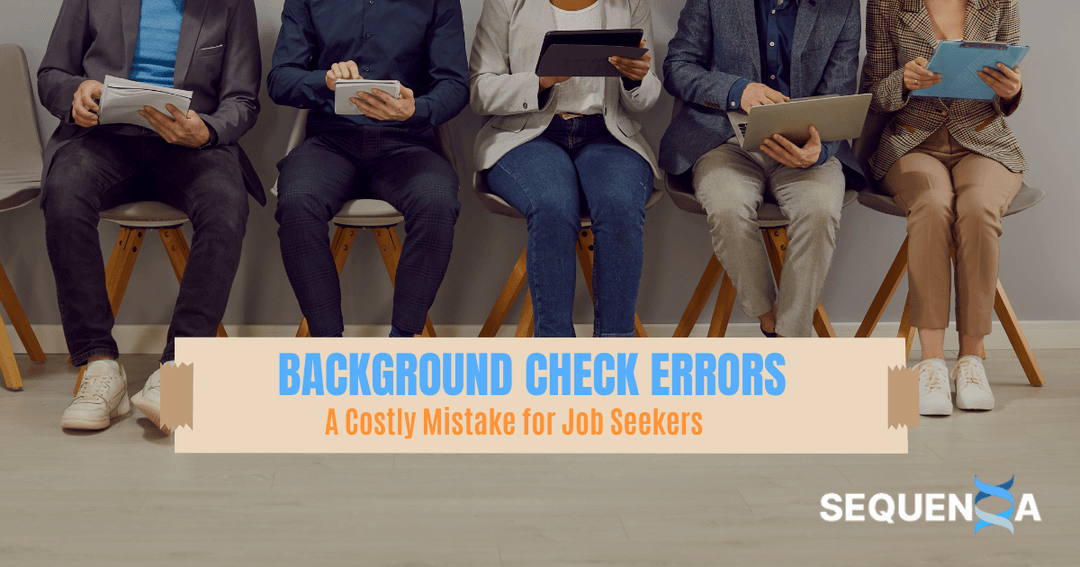
Background checks are supposed to surface the truth. But what happens when the data in the report is not yours? What happens when an arrest that never led to charges, a job you never worked, or a debt that belongs to someone who stole your identity shows up in a hiring report, and costs you a position you had earned?
We have watched this happen to people repeatedly. An incorrect background check does not announce itself. It simply ends an opportunity, quietly, without explanation, and often without the candidate ever knowing why. That is not an accident of the system. That is a failure the system has not been designed to fix on your behalf.
The Scale of The Problem
We do not think the prevalence of background check errors is discussed seriously enough in conversations about hiring. The Consumer Financial Protection Bureau estimates that approximately 1 in 5 background checks contains at least one error. More than one-third of employers have reported finding inaccuracies in the reports they receive. And yet only 14% of Americans know they have the right to request their own employment background report.
Background check mistakes fall hardest on people with common names, people who have experienced identity theft, and people whose records contain outdated or misattributed criminal data. Approximately 70% of background check errors stem from outdated or misreported criminal information (FTC, 2023). The people most likely to be harmed are the people least likely to know they have a right to fight back.
We think that is unacceptable. If your background check for a job is wrong, you have legal recourse. But you cannot use recourse you do not know you have.
What is in a Background Check?

Before we talk about how to fix an incorrect background check, it helps to understand what these reports actually contain, and where errors are most likely to originate. Depending on the role and industry, a report may include:
• Criminal history
• Education verification
• Credit reports (for certain financial or fiduciary positions)
• Driving records
Each category pulls from different databases, many of which are privately maintained, inconsistently updated, and not subject to routine accuracy audits. No central authority verifies the data before it reaches an employer. That is a structural problem, and it creates structural risk for every job seeker whose information passes through these systems.
We say this not to alarm, but to be clear: a problem with a background check for employment does not mean something is wrong with your actual record. It often means something is wrong with the data infrastructure being used to represent you. That distinction matters, because it means the problem is fixable.
Example: A financial firm required credit checks for analysts. One candidate was flagged due to a debt that belonged to someone who had stolen her identity years earlier. The error had nothing to do with her financial history. After a formal dispute, the record was corrected, but the process took three weeks and nearly cost her the offer.
The Background Check Errors We See Most Often
Background check errors are not rare. We want to be direct about that. The most common types we encounter include:
• Criminal records belonging to someone with a similar name or Social Security number - one of the most frequent and most disruptive errors, often caused by loose matching logic in commercial databases.
• Outdated records that should have been expunged or sealed - charges that were legally cleared but never removed from third-party databases, continuing to appear in reports years after the fact.
• Arrest records listed without disposition - no notation that charges were dropped, a case was dismissed, or a defendant was acquitted. An arrest is not a conviction, but without the disposition, it reads like one.
• Incorrect employment dates or fabricated termination reasons - data entry errors or inaccurate reporting from former employers that can make a clean work history look problematic.
• Education credentials matched to the wrong individual - degrees, institutions, or graduation dates assigned to the wrong person, which can appear as misrepresentation even when the candidate never made a false claim.
Any one of these is incorrect information on a background check that can be legally challenged. The problem is that most people do not realize something is wrong until after the rejection has arrived. By then, the decision has already been made, and the person who made it has moved on.
This is why we argue for running a background check on yourself before you apply anywhere. Not after. Not when a problem surfaces. Before, so you are never the last person in the room to know what your report says.
Example: An IT contractor was rejected from a high-security project after someone else's criminal record appeared in his report. The records shared only a similar name and approximate birth year, a data attribution error, nothing more. The dispute corrected it, but the delay cost him six weeks on a project he had already been selected for.
The FCRA Gives You Real Power
The Fair Credit Reporting Act is a federal law, and it is the foundation of every background check dispute process. We raise it not as a technicality but as a practical tool, because the FCRA places enforceable obligations on consumer reporting agencies and gives job seekers rights they can act on immediately.
Here is what the law actually gives you:
• The right to be notified before a background check is conducted, and to give written consent.
• The right to receive a pre-adverse action notice, with a copy of the report and a summary of your rights, before an employer acts on negative findings.
• The right to request a free copy of your background report annually from the consumer reporting agency that produced it.
• The right to dispute incorrect background check information, including the right to dispute criminal background check data that does not belong to you.
• The right to have your dispute investigated within 30 days, with incorrect or unverifiable information corrected or removed.
We want to be clear about something: these are not suggestions. They are legal requirements. A consumer reporting agency that fails to investigate a dispute within 30 days, or that refuses to correct information it cannot verify, is violating federal law.
The FCRA background check dispute process exists because errors are common and the consequences are serious. Knowing how to use it is necessary for anyone looking for a job.
Example: A security officer applicant was denied a position because his report listed an arrest that never resulted in a conviction. He used FCRA dispute protocols to challenge the entry, had the record removed within 30 days, and was re-offered the position. The law worked, because he knew how to use it.
How to Identify Errors in Your Background Check Report?
We believe strongly in this: do not wait for an employer to tell you something is wrong. Run a background check on yourself before you apply. It is one of the most underutilized steps in any job search, and it is the single action that most consistently shifts power back to the candidate.
The cost of finding an error yourself is a few hours. The cost of an employer finding one first can be a job offer, a start date, or a position you had already been selected for. We do not think that is a trade-off worth making when the alternative is this straightforward.
Where to Run a Background Check on Yourself
We recommend using a private background check service. Free reports and court portals have their place, but paid self-check platforms pull from the same commercial databases that employers use, which means you are seeing a closer approximation of what a hiring manager actually receives. That is the whole point of checking early.
Here is what to look for when choosing a self-check service:
• National criminal database coverage - the service should pull from multiple databases across federal, state, and county levels, not just a single aggregated source. A single-source report will miss errors that only appear in county-level records.
• Employment and education verification - look for services that include work history and credential checks, not just criminal data. An employment background check error in your job history can be just as damaging as a misattributed criminal record.
• Sex offender registry and watch list screening - most employer-grade reports include these checks. Your self-check should too, so there are no surprises.
• Credit report access - if you are applying for roles that involve financial responsibility, include a credit component in your self-check. Some paid services bundle this; others require a separate request.
• FCRA-compliant consumer disclosure - the most accurate option is a service that positions itself as a consumer reporting agency and issues a formal consumer disclosure report. This is the same class of report employers receive and gives you the clearest picture of what is on file.
What to Look for Once You Have Your Report
Once the report is in front of you, go through it section by section. Do not skim. We have seen small errors, a wrong middle initial, a transposed date, become the foundation of a misattributed criminal record that took weeks to correct. Here is what to scrutinize:
• Identifying information - your full legal name, aliases, date of birth, current and previous addresses, and Social Security number. Errors here are the most common root cause of records being misattributed to the wrong person.
• Criminal history - read every entry. Confirm each record belongs to you, that the offense listed is accurate, and that the disposition is correctly recorded. An arrest that did not result in a conviction should not appear as one.
• Employment history - cross-reference every employer, job title, start date, end date, and reason for separation against your own records. An employment background check error in this category, particularly a fabricated termination reason, can be among the most damaging to dispute after the fact.
• Education and credentials - confirm that degrees, graduation dates, and institutions are correct. A mismatch here can look like misrepresentation to an employer, even when it is a data entry error on someone else's part.
• Credit data (if applicable) - check for accounts that are not yours, incorrect balances, or derogatory marks that have exceeded the legally reportable timeframe.
How Often We Recommend Running One
At minimum, run a background check on yourself once a year, and always before starting a job search. If you have recently moved across state lines, changed your legal name, experienced identity theft, or had any interaction with the court system, check more frequently. Databases update inconsistently, and new errors can appear at any time without notification.
Example: A teacher found a DUI conviction in her self-requested report that belonged to a woman with the same name in a neighboring county. Because she ran the check before applying, not after a rejection, she had time to dispute it and have it removed in eleven days. She applied to her target school with a clean report.
The Background Check Dispute Process

Disputing false background check data is a defined legal process with defined timelines and defined obligations on the part of the consumer reporting agency. We think this framing matters, because too many people approach a dispute as if they are asking for a favor when they are actually asserting a federal right.
Step 1: Obtain the Report
Identify which consumer reporting agency produced the background check report. If an employer used it against you, they are required by the FCRA to disclose which agency issued it and to provide you a copy. Request it in writing immediately. You cannot dispute background check information you have not seen.
Step 2: Gather Your Documentation
Disputes are won with evidence, not with frustration. To dispute incorrect background check data effectively, and to know how to remove incorrect information from a background check, you need documentation that directly contradicts what is being reported. Collect court records, discharge documents, official employment records, certified transcripts, or identity verification materials. Copies only. Never originals.
Step 3: Submit a Written Dispute
Write a clear, factual dispute letter addressed to the consumer reporting agency. State precisely what is incorrect, why it is incorrect, and what the accurate information is. This is the core of any background check report dispute, and clarity matters more than length. Attach copies of all supporting documents. Send via certified mail with return receipt, or through the agency's official online dispute portal.
Step 4: Notify Your Employer
If a hiring decision has already been affected, notify the employer in writing that you are actively disputing the report. We consider this a critical step that too many people skip. A documented, active dispute can pause or reverse an adverse action, but only if the employer knows one is in progress. This is especially important in an employment background check error dispute involving a pending offer or a recent termination.
Step 5: Follow Up and Track Everything
The consumer reporting agency must complete its investigation within 30 days. Follow up if you have not received confirmation. Keep records of every communication, timestamps, names, and channel. These records are your evidence if you need to escalate to federal regulators or demonstrate how to fix an employment background check error through a formal complaint process.
Example: A marketing executive was incorrectly listed as having been terminated for misconduct, a description her former employer disputed in writing. After submitting offer letters, pay stubs, and a letter from her former manager, the record was corrected within two weeks. Documentation did the work. It almost always does.
What We Have Learned About Winning Disputes
We have seen disputes succeed and disputes fail. The difference is almost never about how persistent someone is. It is about whether the documentation is clear, specific, and directly responsive to the error. Knowing how to fix an incorrect background check is not a matter of pressure, it is a matter of precision.
Here is what we consistently recommend:
• Be specific. When you dispute wrong information on a background check, state exactly what the error is and exactly what the correct information should be. Vague disputes produce vague investigations.
• Submit copies, not originals. You will likely need your documents again, especially if the dispute escalates.
• Notify your employer in writing the moment you initiate a dispute. This preserves your position during the review period and creates a record that the issue was identified, not ignored.
• Escalate if the 30-day window passes. File a formal complaint with the CFPB or FTC. Inaction by a consumer reporting agency after 30 days is a federal violation.
• Seek legal counsel if the error cost you a job or if the reporting agency refuses to correct something you have documented proof is wrong. FCRA violations can entitle you to statutory damages, and in cases of willful noncompliance, punitive damages as well.
Example: A college graduate applying for a teaching position was flagged for drug-related charges that were never hers. Her college transcript, a clean drug test, and a police report showing the charges belonged to someone else resulted in a correction in ten days. The evidence spoke for itself.
Frequently Asked Questions
Can you dispute a background check that cost you a job?
Yes, and we believe more people should. Under the FCRA, you have the legal right to dispute a background check if inaccurate information influenced an employment decision. If the dispute is resolved in your favor, you may also be eligible to request reconsideration from the employer. The sooner you initiate the process, the stronger your position.
How do you dispute a failed background check?
Start by obtaining a copy of the report, then identify the specific error. Submit a written dispute to the consumer reporting agency with all documentation that proves the information is incorrect. Notify your employer in writing that a dispute is in progress. The agency must complete its investigation within 30 days.
How do you dispute criminal background check information that isn't yours?
Gather court records or a police report demonstrating that the charges belong to another individual. Submit these with a written dispute and identity verification documents. If the dispute criminal background check data was misattributed due to a name match, include as much identifying documentation as possible to distinguish your record from the other person's. The agency is legally required to investigate and remove information it cannot verify.
How do you dispute wrong information on a background check?
Write a clear dispute letter to the consumer reporting agency identifying exactly what is wrong and what the correct information is. Attach documentary evidence, court records, employment documents, certified transcripts. Send by certified mail or through the agency's official portal. The FCRA gives the agency 30 days to investigate and respond.
How do you dispute something on your background check if the FCRA background check dispute takes too long?
If the process exceeds 30 days without resolution, file a formal complaint with the Consumer Financial Protection Bureau (CFPB) or the Federal Trade Commission (FTC). We want to be clear: failure to respond within 30 days is itself an FCRA violation. You do not have to wait indefinitely.
How do you fix an employment background check error before it affects future applications?
Run a background check on yourself before you begin applying. If you find an error, initiate a dispute immediately. Resolving an employment background check error proactively means your record is clean before any employer sees it. That is the position we believe every job seeker should be in.
How do you remove incorrect information from a background check?
The removal process runs through the consumer reporting agency that reported the information. Submit a written dispute with supporting documentation. If the agency cannot verify the accuracy of the information, it is legally required to remove it. For expunged or sealed criminal records, include the court order as part of your documentation.
How do you handle a problem with a background check for employment if the employer has already acted?
Notify the employer immediately in writing that you are disputing the background check information. Simultaneously file your dispute with the consumer reporting agency. A documented, active dispute can pause or reverse an adverse action, but the employer needs to know it exists. If a termination has already occurred, consult an employment attorney.
Take Control Before the Next Application
The most effective thing a job seeker can do before submitting an application is run a background check on themselves. Not after receiving a rejection. Not after being asked to explain a discrepancy. Before, because by the time an employer flags something in your report, the decision is often already forming, and you are already behind.
If something does come back wrong, you now know exactly what to do. The dispute process is defined, the law is on your side, and the timeline is enforceable. Run the check. Review the report. And if there is an error, take it on, before it takes the next opportunity from you.
References
Consumer Financial Protection Bureau. (2022). Background check accuracy. Retrieved from https://www.consumerfinance.gov
National Consumer Law Center. (2023). Errors in criminal background checks. Retrieved from https://www.nclc.org
Equifax. (2022). Consumer rights under the FCRA. Retrieved from https://www.equifax.com
Federal Trade Commission. (2023). Report on consumer background check disputes. Retrieved from https://www.ftc.gov
Experian. (2023). Dispute outcomes and trends. Retrieved from https://www.experian.com
Privacy Rights Clearinghouse. (2022). Background check dispute outcomes. Retrieved from https://privacyrights.org
TransUnion. (2022). Background screening dispute trends. Retrieved from https://www.transunion.com