Discord’s Mandatory Age Verification: The Growing Trust Concerns
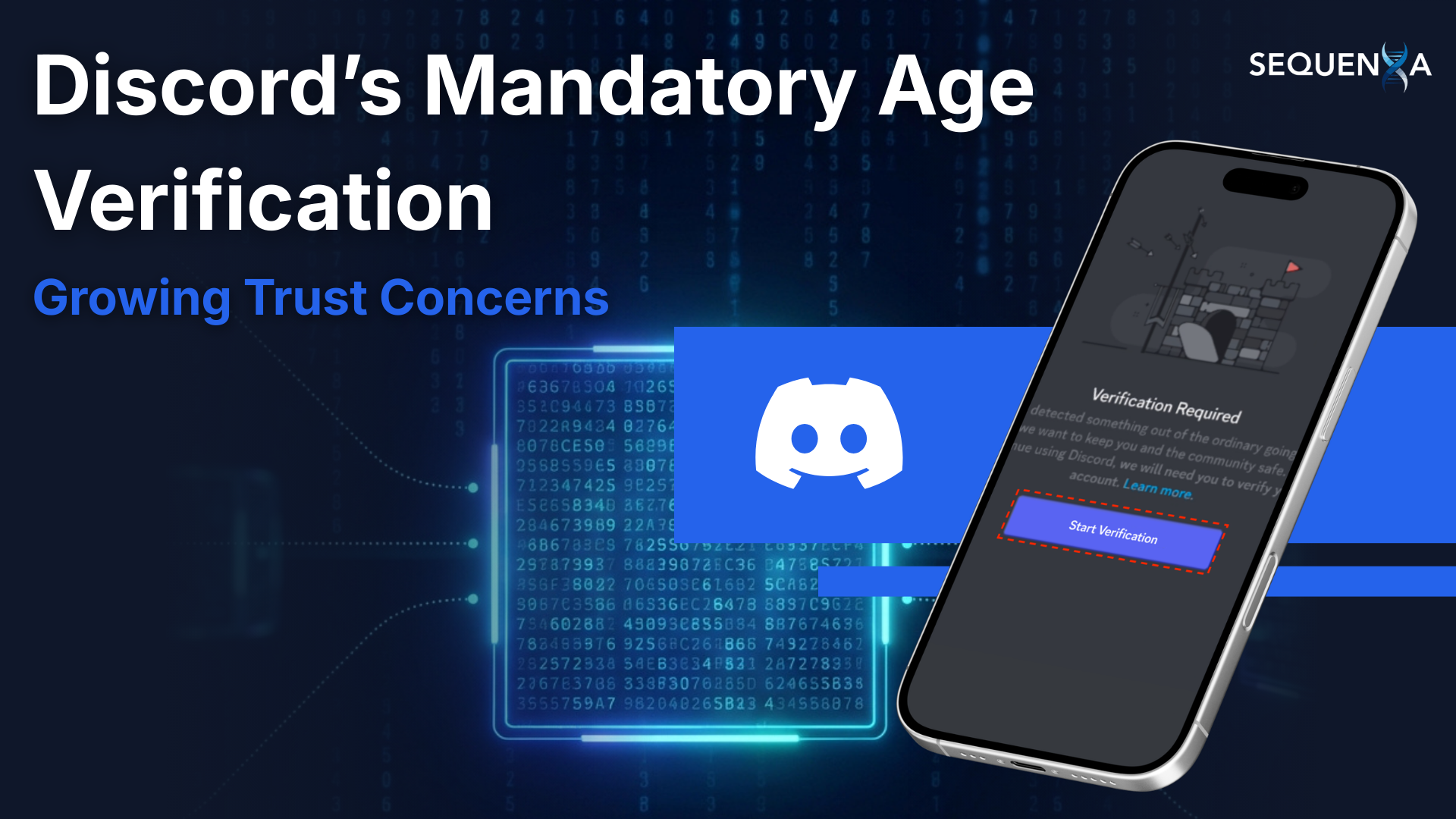
When Discord announced this year that all users might soon have to prove their age, by scanning their face or uploading a government ID, a huge wave of public outrage washed over the platform's 200 million active users.
The Rollout That Backfired
Earlier this month, Discord said it would roll out this global age verification system, framing it as a way to protect teens and comply with emerging online safety laws. It claimed that majority of users would be verified automatically through AI “age inference” using existing account signals, not face scans. But if the system couldn't confidently estimate your age, you'd be asked to use a facial scan or government ID to gain full access.
We understand the broader context. Governments are increasing pressure on platforms to protect minors. Age verification requirements have expanded globally in response to online harms (Ofcom, 2024). Protecting teens matters. We don’t disagree with that goal.
But timing matters too.
Discord had just experienced a breach where a third-party service leaked government ID photos of about 70,000 users. We saw that headline. We read it. And we remembered it.
Data breaches continue to erode public trust, with 60% of consumers saying they would stop using a company after a major data incident (IBM Security, 2023).
So when we are asked for even more sensitive data right after one has already leaked, it doesn’t feel reassuring. It feels risky.
Persona, the Trusted Partner, and Why That's a Problem
One of the age verification vendors Discord briefly tested was Persona, a startup backed by Silicon Valley investors with ties to Peter Thiel, co-founder of Palantir Technologies. Security researchers found exposed code tied to verification workflows, and reporting indicated the system could run broader identity and watchlist screenings beyond simple age checks.
Digital identity verification systems often rely on biometric data, which the National Institute of Standards and Technology warns requires heightened safeguards due to the permanence and sensitivity of facial recognition markers (NIST, 2023).
Discord has since dropped Persona from its rollout, but the backlash hasn't gone away. Many users believe Discord wasn't transparent about how extensive this kind of identity scanning could be, nor how deeply these systems could dig into biometric and personal data.
"I can't trust a platform that messes up my private data and then asks for more of it to stay in the community." — Discord user sentiment shared widely across platforms following the Persona revelations.
Why Users Are Angry, And Why It Matters
Where things become complicated is when the systems built to do that start to feel broader in scope than their stated purpose. We think that gap, between what a system says it does and what it is technically capable of, is where public trust gets lost.
Users say they weren't adequately consulted before these plans rolled out.
Many feel the platform has betrayed the trust of communities that rely on anonymity for safe expression and belonging.
People are signaling fear about uploading IDs to a corporation, especially one that already lost sensitive data once.
Research shows that 81% of consumers believe the risks of data collection outweigh the benefits when companies request highly sensitive information like biometric identifiers (Pew Research Center, 2023).
The story has become less about teen safety and more about a broader privacy panic, one that aligns with rising global concern over biometric tracking and centralized identity systems.
Can Users Trust These Companies With Their Data?
That’s the crux of the issue.
Platforms like Discord will insist their intent is “child safety” and that data is deleted quickly, but intent isn't experience. The moment a third party gets breached or code is accidentally exposed, that trust is gone fast. And in this space, we have seen how quickly that can happen.
Trust recovery after a breach is statistically difficult: 64% of consumers report losing long-term confidence in companies that mishandle sensitive data (Cisco, 2024).
It isn't just about Discord. It's about whether any platform that centralizes identity data, especially one tied to facial recognition or government IDs, can be trusted not to leak, misuse, or repurpose that data later.
We are seeing signals that user confidence is fragile. Which means the bar for how we handle this data has never been higher.
Frequently Asked Questions
Why is Discord forcing age verification?
Discord's mandatory age verification rollout is driven by global regulations like the UK Online Safety Act and similar social media age verification laws in the EU, Australia, and the US.
What is Discord mandatory age verification?
Discord mandatory age verification is a system that requires users to confirm their age before accessing certain features. It’s mainly used to unlock age-restricted content like NSFW channels.
What are Discord teen by default settings?
Discord teen by default settings automatically apply stricter privacy and content filters to users under 18. These settings limit exposure to NSFW servers and direct messages from unknown users.
How to verify age on Discord?
To verify age on Discord, you typically follow an in-app prompt requesting ID upload or face scan verification. The process depends on your country and local regulations.
Can you complete Discord age verification without ID?
Discord age verification without ID may be possible in some regions through alternative checks like facial age estimation. However, availability depends on local compliance rules.
Why is my Discord account locked for age verification?
A Discord account locked age verification notice appears when the system flags your age details. You must complete verification before regaining full access.
Why is Discord age verification stuck pending?
If Discord age verification is stuck pending, it may be due to processing delays or high demand. Waiting 24–48 hours or submitting a support ticket is recommended.
How do I submit a Discord age verification appeal for an underage ban?
A Discord age verification appeal underage ban requires submitting official identification to prove you meet the minimum age. Appeals are handled through Discord’s support portal.
Trust, Incentives, and Ownership
Promises are not protection. A platform can tell you data is deleted within 24 hours. It can frame a biometric surveillance network as a child safety feature. It can publish a privacy policy dense enough to obscure what it actually does. But when a breach happens, and it will, the first question worth asking is not how it happened. It is who built this, and what did they actually want from it?
Are we wrong to question companies' security practices when they have failed time and time again? Discord, Persona. These are not edge cases. These are the most well-resourced organizations in the world, and they still could not protect the data they swore was safe. So when a new platform asks for your face, your documents, and your real identity as the price of entry, skepticism is not paranoia. It is pattern recognition.
Ownership signals incentives. When identity verification firms are backed by venture capital and surveillance-adjacent networks, the calculus becomes clearer: the user is not the customer. The data is the product. Verification is not the destination, it is the on-ramp.
This is the part of the conversation the industry would rather skip. Because the moment you ask who benefits from storing this, the architecture of modern identity verification starts to look less like protection and more like infrastructure built for someone else's purposes.
Trust is not something a company claims. It is something built into the structure from the beginning, and right now, the structure of this industry does not inspire it.
References
Cisco. (2024). Consumer Privacy Survey 2024. Retrieved from https://www.cisco.com
IBM Security. (2023). Cost of a Data Breach Report 2023. Retrieved from https://www.ibm.com/security/data-breach
National Institute of Standards and Technology (NIST). (2023). Face Recognition Vendor Test (FRVT) Ongoing Reports. Retrieved from https://www.nist.gov/programs-projects/face-recognition-vendor-test-frvt
Ofcom. (2024). Online Safety Regulation Update Report. Retrieved from https://www.ofcom.org.uk
Pew Research Center. (2023). Americans and Data Privacy: Concerned, Confused and Feeling Lack of Control. Retrieved from https://www.pewresearch.org