How Digital Forensics Supports Modern Investigations
Most organizations find out they needed digital forensics about three weeks after they actually needed it.
A laptop gets wiped. A cloud account gets deactivated. An employee who left under suspicious circumstances turns out to have transferred 14,000 files to a personal Dropbox the week before their resignation. By the time legal gets involved and someone suggests bringing in a forensic examiner, the window for clean evidence collection has already closed.
That gap between "something happened" and "we need to prove what happened" is where cases fall apart. Not in court. Not during deposition. In the first 72 hours, when digital evidence is either preserved correctly or lost permanently.
Digital forensics is the discipline that closes that gap. And in an environment where the FBI's Internet Crime Complaint Center recorded $16.6 billion in reported cybercrime losses in 2024 alone, a 33% increase over the prior year, the demand for forensic capability that produces court-ready findings is not theoretical (FBI IC3, 2024).
What digital forensics actually is

Digital forensics is the identification, collection, examination, and preservation of electronic data in a manner that maintains its legal admissibility. That last part, legal admissibility, is what separates forensic work from IT troubleshooting.
An IT team can tell you a file was deleted. A forensic examiner can tell you when it was deleted, from which device, by which user account, whether it was overwritten, and whether a recoverable copy still exists in unallocated disk space. More importantly, they can document that entire chain of analysis in a format that a court will accept.
The distinction matters because digital evidence is fragile in ways physical evidence is not. A hard drive that gets powered on without a write blocker can have its metadata altered. A server log that gets overwritten during routine maintenance is gone. An email archive that gets exported without hash verification has no provable chain of custody. NIST's guidelines on digital forensics make this explicit: the chain of custody must document every person who handled the evidence, every transfer, and every reason for that transfer (NIST SP 800-86). Skip any of those steps and you are building a case on a foundation that opposing counsel will dismantle in about four questions.
Why this is a $13 billion problem
The global digital forensics market was valued at roughly $11.7 billion in 2024, with projections placing it near $48 billion by 2034 (Precedence Research, 2024). That growth is not driven by vendor marketing. It is driven by the volume and complexity of matters that now require forensic-grade evidence handling.
Here is what that looks like in practice. In the FBI's 2024 IC3 report, the three most common complaint categories were phishing and spoofing, extortion, and personal data breaches. Investment fraud, particularly cryptocurrency-related schemes, accounted for over $6.5 billion in reported losses. Business email compromise generated another $2.77 billion (FBI IC3, 2024).
Every one of those categories produces digital evidence. Emails, transaction records, IP logs, metadata, browser histories, chat messages, file transfer records. The question is never whether digital evidence exists. The question is whether it was collected in a way that makes it usable.
That is the function digital forensics serves. Not finding data. Making found data defensible.
The investigation process nobody wants to talk about

There is a version of digital forensics that gets described in vendor brochures: plug in the tool, scan the device, generate the report. That version does not exist in practice.
A real forensic investigation follows a sequence that is dictated by legal requirements, not software capabilities. Here is what that actually looks like.
• Identification and scoping. Before a single device gets imaged, the forensic team defines the scope: what systems are potentially relevant, what custodians are involved, what the legal hold requirements are, and what jurisdictional issues apply. In corporate matters, this step often determines whether findings will be admissible. Get the scope wrong and you either collect too little (missing evidence) or too much (raising privacy and proportionality challenges).
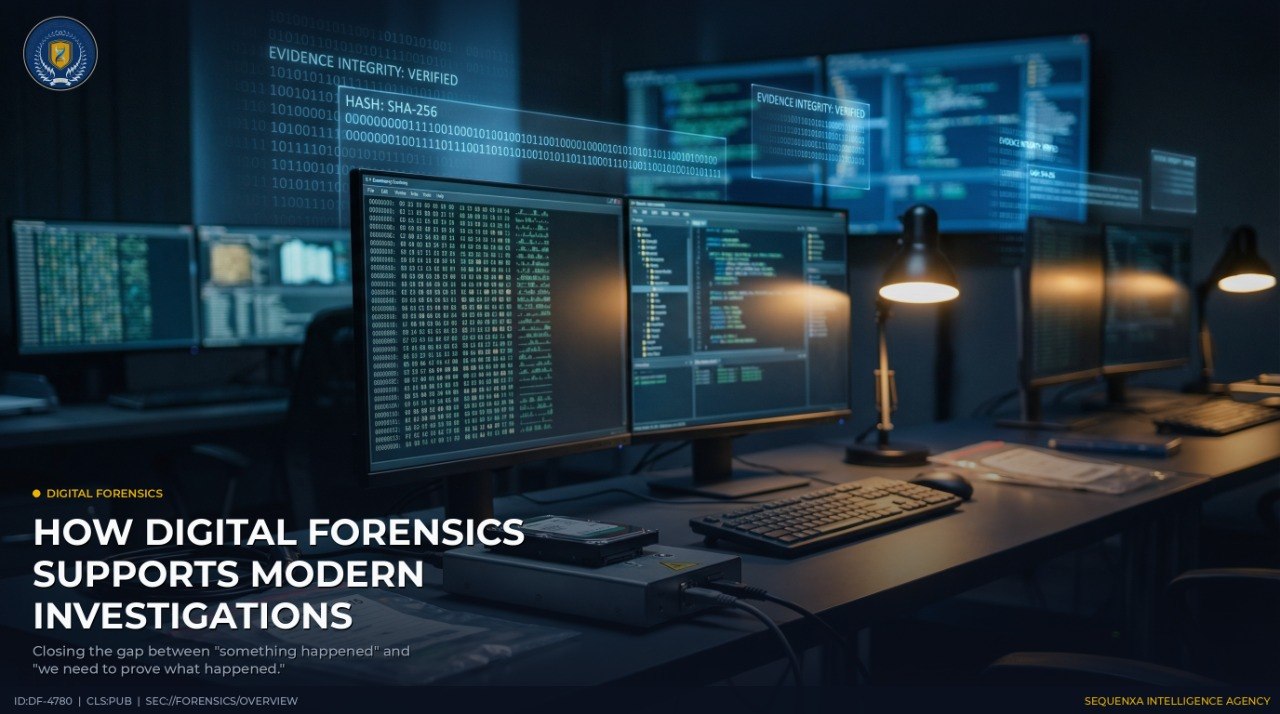
• Evidence preservation. This is the step most organizations botch. Preservation means creating forensic images, bit-for-bit copies, of relevant devices and data sources, verified by cryptographic hash values. SHA-256 is the current standard. The hash generated at the time of collection becomes the permanent reference point: if the hash of the evidence at any later stage does not match the original, the integrity of that evidence is compromised.
Forensic imaging must happen before anyone reviews the data. The moment someone opens a file on the original device, metadata changes. Timestamps update. The evidence is no longer in its original state. This is why write blockers exist and why forensic examiners use them before connecting to any storage device.
• Analysis. This is where the examiner reconstructs what happened. File system analysis reveals deleted files, access patterns, and timeline data. Email forensics maps communication chains. Network forensics identifies data transfers, connection logs, and potential exfiltration points. Memory forensics can recover data that was never written to disk, running processes, encryption keys, chat fragments.
The analysis phase also increasingly involves cloud forensics. As of 2024, cloud forensics accounted for roughly 13% of new forensic deployments, and that number is climbing as more organizational data moves to SaaS and IaaS platforms (Industry Research, 2024). Investigating cloud environments introduces its own complications: data may be stored across multiple jurisdictions, access logs may be controlled by the cloud provider, and the traditional forensic image model does not translate cleanly to environments where you do not control the underlying hardware.
• Reporting and testimony. Findings get documented in a format that legal counsel, regulators, or the court can use. This includes forensic reports, timeline reconstructions, evidence inventories, and, where required, expert witness testimony. The report needs to explain both what was found and how it was found, in enough methodological detail that the analysis can be independently reproduced.
Courts apply standards like the Daubert test to evaluate whether forensic methodology is reliable and whether the expert is qualified to present it. Under Federal Rules of Evidence 901, digital evidence must be authenticated, the proponent has to show it is what they claim it is. That authentication rests entirely on the forensic process. If the methodology is not documented, the evidence does not get in.
Where digital forensics intersects with corporate investigations
In a corporate investigation context, digital forensics is not a standalone service. It is the evidentiary backbone of whatever matter is being investigated.
• Insider threat and data exfiltration. When an employee is suspected of stealing intellectual property or client data, the forensic record is what proves it happened. USB device connection logs, file copy histories, cloud sync activity, email attachments, these artifacts reconstruct the specific actions a person took with specific files at specific times. Research from Purdue University analyzed 936 insider threat cases from U.S. legal records between 2008 and 2024, identifying patterns in tactics and procedures used for data exfiltration that forensic examiners now use as investigative starting points (Purdue University, 2024). Reports from 2024 indicate that 83% of companies experienced at least one insider attack that year, frequently involving data exfiltration by employees (Soni, 2025).
• Financial fraud. Forensic accounting and digital forensics converge when fraud involves electronic transactions, manipulated records, or falsified digital documents. A spreadsheet that has been altered leaves forensic traces in its metadata. An invoice that was backdated shows timestamp inconsistencies. Email chains that were selectively deleted to hide approval of unauthorized transactions can often be recovered from server-side backups or through e-discovery processes.
• Regulatory and compliance investigations. When a regulator comes asking questions, the organization that can produce a forensic-grade evidence package, hash-verified, chain-of-custody documented, methodologically sound, is in a structurally different position than the one that hands over a folder of screenshots and exported PDFs.
• Litigation support. In e-discovery, digital forensics determines what electronically stored information exists, where it resides, how to collect it defensibly, and how to review it efficiently. The volume problem alone is substantial. Modern investigations routinely involve terabytes of data across dozens of custodians and multiple platforms. Without forensic methodology governing collection, the producing party risks spoliation claims, sanctions, and adverse inference rulings.
What most organizations get wrong
The most common mistake is treating digital forensics as something you bring in after things go sideways. By then, evidence has been handled improperly, devices have been reissued or wiped, and logs have rolled past their retention window.
Here is what that looks like in a real scenario. An organization discovers potential fraud. Internal IT pulls some email exports and hands them to legal. Legal reviews the emails and decides to bring in a forensic firm. The forensic firm asks for the original mailbox data and server logs. IT says the exports were done weeks ago and the server logs have since been overwritten. The forensic firm can work with the exports, but they cannot verify that the exports are complete or unaltered, because no hash was generated at the time of collection.
That organization now has evidence that an opposing party will challenge on integrity grounds. Not because anyone tampered with anything, but because nobody followed the process that would prove they did not.
The other common error is assuming that IT capabilities and forensic capabilities are interchangeable. Your IT team manages systems. A forensic examiner investigates them. Those are different disciplines with different training, different toolsets, and different standards of documentation. Using one for the other's job produces results that look adequate until they get tested.
The AI question
Machine learning is entering the forensic space. Roughly 25% of new forensic tool suites now include AI or machine learning capabilities for pattern recognition, log filtering, and anomaly detection (Industry Research, 2024). NIST research has shown that AI-driven deepfake audio detection has reached 92% accuracy (NIST, 2024).
But AI in forensics introduces a specific problem: courts are beginning to scrutinize whether AI-derived findings meet admissibility standards. The transparency of the algorithm, the quality of the training data, and the reproducibility of the results all become questions that an expert witness must be prepared to answer. AI can surface leads faster. It cannot replace the forensic methodology that makes those leads usable in proceedings.
The practical recommendation is straightforward: use AI to accelerate analysis, but anchor every finding in authenticated digital artifacts and documented methodology. Treat AI outputs as investigative leads, not as evidence.
When you need forensic capability and when you do not
Not every IT incident requires a forensic investigation. A password reset does not need chain-of-custody documentation. A routine phishing attempt that was caught and blocked does not need forensic imaging.
But certain triggers should remove ambiguity. If any of the following apply, the answer is forensic investigation, not internal review:
An employee has departed and there are signs of data exfiltration or intellectual property theft. Financial irregularities have surfaced that may involve manipulation of electronic records. A regulatory inquiry is active or anticipated and the organization needs to produce defensible evidence. Litigation is pending or probable and electronically stored information is relevant. A cybersecurity incident has occurred that may involve criminal activity or require notification under breach disclosure laws.
In those scenarios, the question is not whether digital forensics is necessary. It is whether the forensic process starts soon enough to preserve what matters.
The uncomfortable part
Most organizations do not have forensic readiness plans. They have incident response plans that assume IT will handle collection and legal will handle review. That assumption holds until the matter ends up in court or before a regulator, and the other side asks a simple question: who collected this evidence, what methodology did they follow, and can you demonstrate that the evidence was not altered between collection and presentation?
If the answer is anything other than a documented forensic process with hash verification and chain-of-custody records, the evidence is vulnerable. Not because it is wrong. Because it cannot be proven right.
That is the operational reality digital forensics addresses. Not finding things, anyone with the right tools can find things. Proving what you found, in a way that holds up when someone whose job it is to take it apart tries to do exactly that.
See how our digital forensics capabilities support investigations from first response through court preparation, or request a consultation to discuss your specific matter.
Frequently asked questions
What is digital forensics?
Digital forensics is the process of identifying, collecting, preserving, analyzing, and reporting on electronic data in a way that maintains its integrity and legal admissibility. It applies to data from computers, mobile devices, cloud platforms, networks, and other digital systems, and is used in criminal investigations, corporate matters, regulatory inquiries, and civil litigation.
What is the digital forensics investigation process?
A forensic investigation follows a structured sequence: scoping and identification of relevant data sources, preservation through forensic imaging with hash verification, analysis using validated forensic tools and methodologies, and reporting that documents both findings and methodology in a format suitable for legal proceedings.
What types of cases use digital forensics?
Digital forensics supports a wide range of matters including cybercrime investigations, insider threat and data exfiltration cases, financial fraud investigations, intellectual property theft, regulatory compliance inquiries, employment disputes involving electronic records, and civil litigation requiring e-discovery.
How is digital evidence preserved?
Digital evidence is preserved by creating forensic images, bit-for-bit copies, of source data, verified with cryptographic hash algorithms such as SHA-256. Write blockers prevent any changes to original media during acquisition. Every transfer and access is documented through chain-of-custody records to ensure the evidence can be authenticated in court.
Why can't internal IT handle forensic investigations?
IT teams manage systems for operational purposes. Forensic investigators examine systems for evidentiary purposes. The methodologies, documentation standards, toolsets, and legal requirements are different. Findings produced without forensic methodology may not be admissible in court and may not withstand challenge from opposing counsel regarding evidence integrity and chain of custody.
References
Association of Certified Fraud Examiners (ACFE). (2024). Occupational Fraud 2024: A Report to the Nations. Retrieved from https://legacy.acfe.com/report-to-the-nations/2024/
Federal Bureau of Investigation (FBI). (2024). 2024 Internet Crime Report. Internet Crime Complaint Center (IC3). Retrieved from https://www.ic3.gov/AnnualReport/Reports/2024_IC3Report.pdf
Industry Research. (2024). Digital Forensics Market Size, Trends and Forecast 2034. Retrieved from https://www.industryresearch.biz/market-reports/digital-forensics-market-110892
National Institute of Standards and Technology (NIST). (2006). Guide to Integrating Forensic Techniques into Incident Response (SP 800-86). Retrieved from https://nvlpubs.nist.gov/nistpubs/legacy/sp/nistspecialpublication800-86.pdf
National Institute of Standards and Technology (NIST). (2022). Digital Evidence Preservation (NIST IR 8387). Retrieved from https://nvlpubs.nist.gov/nistpubs/ir/2022/NIST.IR.8387.pdf
Precedence Research. (2024). Digital Forensics Market Size to Hit USD 47.9 Billion by 2034. Retrieved from https://www.precedenceresearch.com/digital-forensics-market
Purdue University Graduate School. (2024). Insider Threats: Trend Analysis of the Tactics, Techniques, and Procedures in Computer-Related Insider Threat Cases. Retrieved from https://hammer.purdue.edu/articles/thesis/b_INSIDER_THREATS_TREND_ANALYSIS_OF_THE_TACTICS_TECHNIQUES_AND_PROCEDURES_IN_COMPUTER-RELATED_INSIDER_THREAT_CASES_b/30166756
Soni, N. (2025). Digital Forensics: Confronting Modern Cyber Crimes, Technological Advancements, and Future Challenges. Journal of Forensic Legal & Investigative Sciences. Retrieved from https://www.heraldopenaccess.us/openaccess/digital-forensics-confronting-modern-cyber-crimes-technological-advancements-and-future-challenges
Ready to Take the Next Step?
Learn how Sequenxa can help protect your organization with intelligence-driven solutions.
Get Started