
Sequenxa Intelligence
[ Intelligence ]Aviation Safety: From X-Ray to Behavioral Threat Detection
Airport scanners detect objects. Behavioral threat detection addresses intent. Learn what X-ray and body scanner can see, and where predictive threat intelligence takes over.
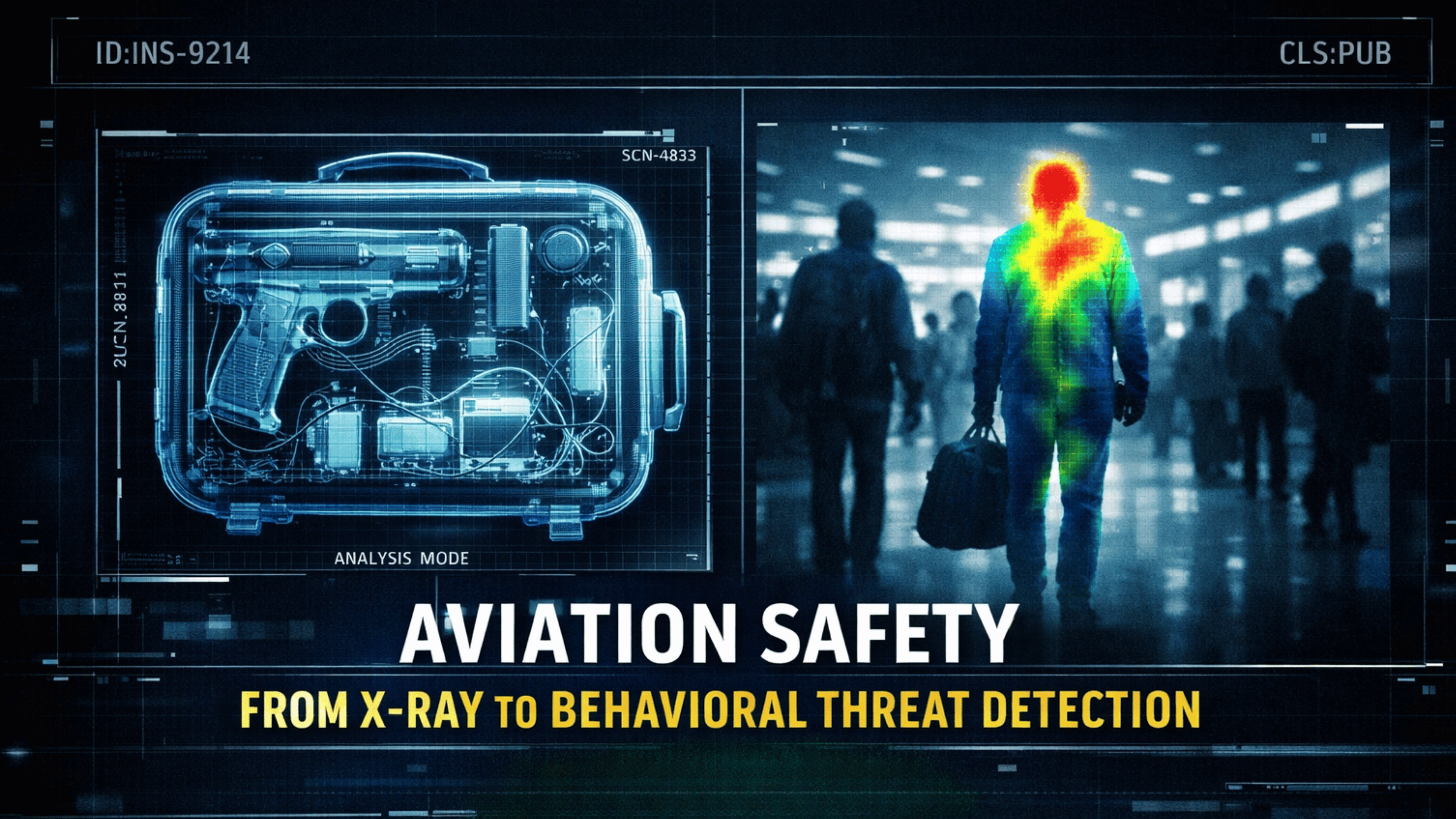
Every major airport checkpoint runs on the same foundational assumption: if you remove the weapon, you remove the threat. That assumption has shaped billions of dollars in screening infrastructure, and it remains only partially correct.
Airport scanners detect objects. Behavioral threat detection addresses intent. The gap between those two capabilities is where modern aviation risk concentrates.
How Aviation Security Evolved
The history of aviation security is a history of reactive upgrades. Each generation of screening technology was introduced in response to a failure the previous generation couldn't prevent. The major generational shifts look like this:
• 1970s: Metal detectors deployed at passenger checkpoints following a surge in aircraft hijackings
• 1980s–1990s: X-ray baggage screening expanded to carry-on and checked luggage; automated threat detection algorithms introduced
• 2001–present: TSA established; full-body scanner technology fast-tracked; behavioral detection programs introduced alongside physical screening for the first time at scale
Each upgrade expanded what screening could see. None of them resolved the fundamental ceiling: physical screening is object-oriented. It identifies what is present. It does not assess what is intended.
What Airport Scanners Actually See

How Baggage X-Ray Imaging Works
Airport baggage X-ray machines work by passing a focused beam of X-ray energy through luggage and measuring how different materials absorb that energy. The imaging output reflects three variables:
• Density: How much the material resists X-ray penetration
• Shape: The outline and structure of the item as rendered by the energy differential
• Material class: Whether the item registers as organic, inorganic, or mixed composition
Do Airport Scanners Detect Drugs?
What do X-ray machines at airports see when it comes to drugs? This is where the technology's limits become operationally significant. Airport scanners cannot definitively identify a substance as a controlled drug by image alone.
• What do pills look like on an airport X-ray? Pill bottles and tablet clusters appear as dense organic masses, distinguishable in shape from surrounding items, but not chemically identifiable without additional screening
• Drugs in powder form render as soft organic material with no distinct visual signature
• Liquid substances are flagged by volume, not chemical composition
• Drugs concealed within food items, clothing fabric, or hollowed objects may not produce a detectable anomaly at all
What Other Items Are Detectable
What do cigarettes look like on airport X-ray? Dense, uniform organic clusters, visually similar in profile to other tightly packed materials. A full carton produces a distinctly regular rectangular mass that stands out against soft goods. Beyond obvious weapons and contraband, what can airport scanners see in luggage includes:
• Electronics and battery configurations that match known device profiles
• Liquids above permitted volumes, identified by container shape and density
• Structural modifications to luggage, false bottoms, reinforced cavities, visible as density inconsistencies
• Dense organic anomalies that fall outside expected luggage content profiles
The practical ceiling remains consistent: the scanner flags what looks unusual. It does not confirm what the unusual item is.
Former TSA Administrator noted: "Technology is only as good as the operator interpreting it and the system surrounding it. A scanner is a tool. It is not a security strategy."
Body Scanners and the Human Variable
What TSA Full-Body Scanners Actually Produce
What does TSA see when they scan you? The answer depends on which technology is in use. Millimeter wave scanners, the most common full-body scanner type currently deployed by TSA, produce a generic avatar image that highlights anomalies on the body surface. What do airport body scanners see is not a photographic representation of the individual but a mapped outline with flagged regions where an object may be present.
Current TSA body scanner operation works as follows:
• The individual passes through the scanner unit
• A millimeter wave pulse maps the body surface contour
• An algorithm reviews the output for anomalies against a standardized profile
• If no anomaly is detected, the individual proceeds
• If an anomaly is flagged, a same-gender officer conducts a targeted pat-down of the indicated region
TSA body scanner images are reviewed algorithmically in most current deployments. They are not stored, transmitted, or retained after the screening interaction.
Can Airport Scanners See Inside Your Body?
Can airport scanners see inside your body? Millimeter wave technology does not penetrate the body, it reads the surface and identifies objects beneath clothing. What the scanner at the airport sees is the contour of the body and anything positioned between skin and outer garment.
Backscatter X-ray systems, which were phased out of U.S. airports by 2013, produced more anatomically detailed images, but were removed precisely because of privacy concerns related to what TSA body scan images revealed. Images of TSA full body scanner outputs that circulate publicly are largely from the backscatter era and are not representative of current millimeter wave technology.
The Privacy and Storage Question
What can airport scanners see on body in terms of concealed threats? Surface-level concealment is detectable. What is not detectable includes:
• Internal body concealment, which falls outside millimeter wave scanning capability
• Items stored in body cavities
• Micro-concealment beneath skin-tight layering that doesn't produce sufficient density contrast
Under current TSA policy, images of airport scanners are neither stored nor transmitted after the screening interaction. The review is real-time and the image is discarded immediately after assessment.
Where the Body Scanner Stops
The more significant limitation is not anatomical. It is behavioral. A full-body scan that returns no anomaly tells an operator that a subject is not carrying a detectable concealed object at that moment. It tells them nothing about:
• The subject's intent
• Their access history at the facility
• Their associations or known threat affiliations
• The behavioral indicators they may have exhibited before reaching the checkpoint
Behavioral psychologist and pioneer of deception detection research, has observed: "The face and body leak information that cannot be concealed the way a weapon can. The challenge is building systems that are designed to read those signals, not just the luggage."
Where Physical Screening Falls Short

The Insider Threat
The most significant aviation security failures of the past two decades share a common thread. They did not occur because screening technology failed to detect an object. They occurred because the human threat variable was not identified before or during the checkpoint encounter.
Insider threats represent the most structurally significant gap. Airport employees, ground crew, baggage handlers, catering staff, maintenance personnel, operate in sterile zones with credentialed access that bypasses the public screening checkpoint entirely. The 2015 Metrojet bombing over the Sinai Peninsula, which killed all 224 people aboard, is widely attributed to an explosive device loaded by an airport employee, not smuggled through passenger screening. No X-ray machine was circumvented. The threat entered through an access point that physical screening was never designed to cover.
Social Engineering at Access Points
Social engineering at access control points is the second major gap. Manipulating human gatekeepers, through impersonation, credential misrepresentation, or the exploitation of procedural familiarity, does not require defeating any technology. It requires understanding human behavior and institutional routine well enough to exploit both. Aviation environments, with their shift-based workforces and high-volume operational pressure, are structurally susceptible to this vector.
Pre-Boarding Behavioral Indicators
Pre-boarding behavioral indicators represent the third gap. Individuals who present a threat profile frequently exhibit observable behavioral signals, stress responses, route deviations, interaction anomalies, that appear before the checkpoint is reached. A screening model built entirely around the checkpoint moment discards that observational window entirely (Government Accountability Office, 2023).
Former FAA Red Team leader and aviation security whistleblower, has stated: "We kept proving the system could be defeated. The response was almost always to add another layer of the same kind of screening that had already failed, rather than to rethink what we were actually trying to detect."
What Behavioral Threat Detection Actually Involves
Behavioral threat detection is a structured analytical discipline, one that applies observable behavioral indicators against established baselines to identify individuals whose profile warrants further assessment.
The core methodology involves three elements. First, baseline establishment: understanding what normal behavior looks like in a given environment so that deviations become legible. Second, indicator identification: recognizing the specific behavioral signals, physiological stress responses, proxemic anomalies, verbal inconsistencies, route and timing deviations, that correlate with heightened threat probability. Third, structured assessment: applying a repeatable analytical protocol to evaluate whether observed indicators, in combination, cross a threshold that warrants intervention.
Predictive threat intelligence formalizes this methodology into an organizational capability. Rather than relying on checkpoint observation alone, a structured threat intelligence function aggregates behavioral signals across multiple touchpoints, pre-travel patterns, access history, communication indicators, and real-time observational data, to build a threat profile before the individual reaches any physical screening point (Association of Threat Assessment Professionals, 2023).
This is the operational difference between reactive screening and proactive threat intelligence. Reactive screening asks: does this person have something they shouldn't? Proactive threat intelligence asks: does this person intend to do something they shouldn't, and what signals preceded that intent?
The distinction matters because the answer to the first question can be engineered around. The answer to the second is substantially harder to conceal.
Forensic psychologist and behavioral threat assessment specialist, notes: "Targeted violence is never spontaneous. There is always a pathway, a sequence of behaviors, communications, and decisions that precede the act. The question is whether anyone was looking at the right signals early enough to intervene."
The Social Engineering Dimension
How Access Is Actually Obtained
Physical screening infrastructure operates on the assumption that threats are material, detectable because they take up space, have mass, and produce a signature on imaging equipment. Social engineering exploits the dimension that physical screening cannot address: the human willingness to extend trust when institutional cues are present.

In aviation environments, the three primary social engineering access patterns are:
• Credential exploitation: Using legitimate or fraudulently obtained access credentials to enter restricted areas without triggering screening protocols
• Authority impersonation: Presenting behavioral and contextual signals that cause gatekeepers to defer rather than verify
• Procedural familiarity: Demonstrating sufficient knowledge of operational routine to pass as an insider without formal credential confirmation
What Social Engineering Assessments Reveal
Social engineering assessments, structured adversarial simulations that test the human layer of a security posture, reveal vulnerabilities that no scanner can identify. Specifically, they test:
• Whether access control personnel challenge unfamiliar individuals or defer to apparent authority
• Whether procedural verification holds under social pressure or collapses when time constraints are
applied
• Whether the cultural norms of an operational environment have created exploitable patterns of routine deference
• Whether staff can distinguish between genuine credentials and plausible imitations under operational conditions (Mitnick & Simon, 2002)
The Consistent Finding
The findings from social engineering assessments in aviation-adjacent environments consistently show that the human layer is the most reliable point of failure, not because personnel are undertrained, but because the screening model was not designed with the human variable as a primary threat surface (International Air Transport Association, 2023).
Former social engineer and security consultant, stated plainly: "Companies spend millions of dollars on firewalls, encryption, and secure access devices, and it's money well spent. But none of these measures address the weakest link in the security chain, the people who use, administer, and operate these systems."
Practical Implications for High-Risk Environments
Organizations responsible for aviation security, executive transport, private terminal operations, or high-value asset movement face a structural decision: whether their threat assessment framework is built around what screening can detect or around what intelligence can anticipate.
What a Physical-Only Model Misses
A physical screening model optimized to the highest current standard will reliably detect known threat signatures. It will not detect:
• Novel concealment methods that fall outside trained pattern recognition
• Insider threat actors operating within their credentialed access permissions
• Individuals whose behavioral profile warrants assessment but whose physical screening produces no anomaly
• Social engineering attempts that exploit human gatekeepers rather than physical checkpoints
• Pre-boarding threat indicators that emerge before the screening interaction begins
What a Layered Intelligence Approach Covers
A layered approach that integrates physical screening with intelligence-led threat assessment addresses the full threat surface. The components of that approach include:
• Physical screening infrastructure for object detection at access points
• Behavioral threat assessment protocols for pre-checkpoint and checkpoint observation
• Access intelligence review covering credentialed personnel and insider risk
• Social engineering vulnerability assessment of human access control layers
• Predictive threat monitoring that aggregates signals across multiple touchpoints over time
The practical starting point is assessment. Understanding where the human-layer vulnerabilities in a given environment exist, what behavioral detection capability is currently deployed, and what the gap is between current screening posture and the actual threat profile of the environment. That gap is where the operationally significant risk lives, and it is not visible on any scanner image.
Frequently Asked Questions
What can airport scanners see in luggage?
Airport baggage scanners use X-ray imaging to detect the shape, density, and material composition of items inside luggage. They can identify metallic objects, weapons, explosive components, and dense organic masses. They do not chemically identify substances, what they produce is a visual profile that trained operators assess for anomalies.
Do X-ray machines detect drugs?
X-ray machines do not chemically identify drugs. They detect density and shape irregularities that may be consistent with concealed substances. Confirmation requires secondary screening, swab testing, canine detection, or physical inspection. An X-ray image can flag a suspicious mass; it cannot confirm what that mass is.
What do pills look like on an airport X-ray?
Pills and tablet containers appear as dense, uniform organic clusters on X-ray imaging, lighter in tone than metals, darker than soft organic material. They are visually distinguishable from surrounding items by their regularity of shape and density, but are not chemically identifiable by image alone.
Drug airport baggage scanner images, what do they actually show?
Scanner images of suspected drug concealment show density anomalies, irregular masses, unusual layering, or items that don't match the expected profile of declared luggage contents. The image flags the anomaly. Identification of the substance requires additional testing.
What do cigarettes look like on airport X-ray?
Cigarettes appear as tightly packed, uniform organic material, dense relative to clothing or soft goods but significantly lighter than metal. A carton of cigarettes produces a distinctly regular rectangular profile on X-ray imaging.
What can airport baggage scanners see beyond weapons?
Beyond weapons and explosive components, baggage scanners can identify dense organic anomalies, unusual layering patterns, and items that don't match declared contents. Electronics, liquids above permitted volumes, and structural modifications to luggage are also detectable, though confirmation of any finding requires operator assessment and secondary screening.
How do airport scanners detect drugs in luggage?
They don't detect drugs directly. They detect visual anomalies, shapes and densities that fall outside the expected profile of normal luggage contents. When an anomaly is flagged, secondary protocols, physical search, swab testing, or canine screening, are used to confirm or rule out the presence of a controlled substance.
What does the scanner at the airport see on a body scan?
Millimeter wave body scanners produce a generic avatar image with flagged regions where an anomaly is detected beneath clothing. They do not produce anatomical photographs. The image identifies surface-level concealment, items between skin and outer garment, and highlights those locations for operator review.
What do airport body scanners see?
Full-body scanners detect objects concealed beneath clothing on the body surface. They do not see through the body or detect internal concealment. The output is a mapped outline with flagged anomaly regions, not a detailed image of the individual.
What does TSA see when they scan you?
In current TSA deployments using millimeter wave technology, operators see a generic human outline with highlighted regions indicating potential anomalies. Personal anatomical detail is not visible. If an anomaly is flagged, a same-gender officer conducts a targeted pat-down of the indicated area.
Can airport scanners see inside your body?
Millimeter wave scanners cannot see inside the body, they read the surface contour and detect objects between skin and clothing. Internal concealment is outside the operational scope of standard passenger screening technology.
What can airport scanners see on body?
Surface-level concealment, items strapped to the torso, thighs, or placed within clothing, is detectable. The scanner identifies the location of an anomaly; it does not identify the nature of the object. Follow-up physical screening determines what the flagged item is.
TSA body scanner images, what do they look like?
TSA millimeter wave scanner outputs are not photographic. They display a standardized human figure outline with color-coded or highlighted markers indicating where an anomaly has been detected. These images are reviewed algorithmically in most current deployments and are not retained after screening.
Images from airport body scanners, are they stored?
Under current TSA policy, millimeter wave scanner images are not stored or transmitted. The image is reviewed in real time and deleted after the screening interaction. Earlier backscatter X-ray systems, which produced more detailed images, were removed from U.S. airports by 2013 in part due to privacy concerns related to image detail.
What does the airport X-ray see in checked baggage?
Checked baggage X-ray screening uses the same imaging principle as carry-on screening but at higher throughput volumes. The system flags density anomalies, shape irregularities, and items that match known threat profiles. Flagged bags are pulled for physical inspection or secondary automated screening.
Airport X-ray machine, how does it work?
An airport X-ray machine passes a focused beam of X-ray energy through the item being screened. Different materials absorb the energy at different rates, metals absorb more and appear darker, organic materials absorb less and appear lighter. The resulting image maps the density and shape of everything inside the bag, which trained operators assess against known threat profiles and anomaly indicators.
Where to Start
Organizations that have moved beyond object-detection models have done so by investing in predictive threat intelligence as a formal operational function, one that runs parallel to physical screening rather than waiting for it to fail. The difference between those organizations and the ones that get caught flat-footed is not equipment. It is whether they built a system designed to see what scanners cannot.
Physical screening tells you what someone is carrying. Predictive threat intelligence tells you what they intend to do. If your current security posture is built entirely around the former, the gap between the two is your most significant unmanaged risk.
References
Association of Threat Assessment Professionals. (2023). Behavioral Threat Assessment and Management: Best Practice Guidelines. Retrieved from https://www.atapworldwide.org/resources
Ekman, P. (2009). Telling Lies: Clues to Deceit in the Marketplace, Politics, and Marriage. W. W. Norton & Company.
Government Accountability Office. (2023). Aviation Security: TSA Screening Effectiveness and Behavioral Detection Programs. Retrieved from https://www.gao.gov/products/aviation-security
International Air Transport Association. (2023). Aviation Security Report: Threat Landscape and Screening Innovation. Retrieved from https://www.iata.org/en/programs/security
Meloy, J. R., & Hoffmann, J. (Eds.). (2021). International Handbook of Threat Assessment (2nd ed.). Oxford University Press.
Mitnick, K., & Simon, W. L. (2002). The Art of Deception: Controlling the Human Element of Security. Wiley.
Schneier, B. (2012). Liars and Outliers: Enabling the Trust That Society Needs to Thrive. Wiley.
Transportation Security Administration. (2023). Screening Technology and Behavioral Detection Overview. Retrieved from https://www.tsa.gov/travel/security-screening