
Sequenxa Intelligence
[ Intelligence ]Compliance Automation: Managing Regulatory Risk at Scale
Human error is attributed to 90% of data breaches. (Liquibase, n.d.) Manual compliance processes, where analysts pull logs, review configurations, and generate reports by hand, are the exact environment where that error rate accumulates. A misconfigured access control, a missed audit log, a policy check skipped during a busy quarter: each one is a gap that automated systems close before it becomes a violation.
Human error is attributed to 90% of data breaches. (Liquibase, n.d.) Manual compliance processes, where analysts pull logs, review configurations, and generate reports by hand, are the exact environment where that error rate accumulates. A misconfigured access control, a missed audit log, a policy check skipped during a busy quarter: each one is a gap that automated systems close before it becomes a violation.
Compliance automation replaces those manual checks with continuous, rule-based enforcement that runs without human intervention. For organizations subject to SOC 2, GDPR, HIPAA, PCI-DSS, CCPA, or SOX, the result is fewer gaps, faster audits, and a compliance posture that does not degrade between review cycles.
What Is Compliance Automation?
Compliance automation is the use of rule-based systems to continuously monitor, enforce, test, and report on an organization's adherence to regulatory and security policy requirements. It replaces periodic manual audits with real-time checks that run on a defined schedule or in response to system events. (Swimlane, 2026; Sprinto, 2026)
Regulatory automation is the broader category. Security compliance automation is the application within IT and information security programs, covering access controls, configuration management, vulnerability status, data handling policies, and audit logging.
The core value is consistency. A manual compliance process is only as reliable as the analyst running it. An automated compliance process runs the same checks the same way every time, logs the results, and generates alerts when something drifts out of policy.
"Compliance automation does not make audits disappear. It makes the evidence collection fast enough that audit preparation stops being a crisis and starts being a routine."
Database Security Compliance Automation
Databases are among the highest-risk compliance surfaces in any organization. They hold personally identifiable information, financial records, health data, and intellectual property. A single misconfigured permission or an unlogged access event can constitute a regulatory violation under GDPR, HIPAA, or PCI-DSS.
Database compliance automation enforces role-based access controls, validates schema and configuration changes against policy before deployment, logs all data access activity, and generates audit-ready reports at defined intervals. (DBmaestro, 2026; Liquibase, n.d.)
For organizations using CI/CD pipelines, database compliance automation integrates directly into the deployment workflow. A change that violates a compliance rule is flagged before it reaches production, not after an auditor finds it.
Automated IT security policy compliance systems extend the same logic to the broader infrastructure layer, covering cloud configurations, endpoint settings, network access controls, and identity management systems. The goal is the same: continuous validation that the environment matches the policy that governs it. (DBmaestro, 2026; DBWatch, 2025)
How Automated Compliance Monitoring, Testing, and Reporting Work
Three functions make up the operational core of a compliance automation program:
Automated compliance monitoring provides continuous real-time surveillance of systems against defined policy baselines. When a configuration drifts, an access control changes, or a new asset appears outside of approved parameters, the system generates an alert and logs the event. Monitoring does not wait for a scheduled review. It runs constantly. (Swimlane, 2026; SureCloud, 2026)
Automated compliance testing runs scheduled or triggered tests that validate whether specific controls are operating as required under a given framework. Each test maps to a control objective, produces a pass or fail result, and logs evidence. For SOC 2 or ISO 27001 audits, this means control evidence is generated automatically throughout the year rather than assembled manually before an audit window. (Sprinto, 2026; Linford, 2025)
Automated compliance reporting pulls data from integrated systems, applies predefined reporting rules, and produces standardized documentation at set intervals. What previously required analysts to spend weeks compiling audit evidence can be reduced to hours. Reports are formatted to match framework requirements and are exportable for auditor review. (Qarma, n.d.; Lucid.now, 2025)
"The biggest shift compliance automation creates is moving organizations from reactive to proactive. Instead of scrambling to prove controls were in place, they have continuous evidence that they were."
What to Look for in Compliance Automation Tools
Compliance automation platforms vary in scope, but the core capabilities that make them operationally effective are consistent across serious implementations.
Multi-framework coverage. The platform should map controls across multiple frameworks simultaneously, SOC 2, HIPAA, GDPR, PCI-DSS, ISO 27001, and others, so that evidence collected for one audit supports another. (Centraleyes, 2024; Cynomi, 2025)
Continuous monitoring. Scheduled scans are not enough for environments that change frequently. Effective security compliance tools monitor in real time and alert on deviation, not just at the next scheduled check.
Automated evidence collection. Access logs, configuration snapshots, audit trails, and change records should be collected automatically from integrated systems. Manual evidence collection reintroduces the human error problem automation is designed to eliminate. (Linford, 2025)
Remediation workflows. Detection without action is noise. Compliance automation software that closes the loop from alert to assigned remediation task to verified resolution is materially more effective than systems that only generate reports. (Zluri, 2026)
Audit-ready output. Reports should be formatted to match auditor expectations for the relevant framework, exportable, and time-stamped to demonstrate continuous operation rather than pre-audit preparation. (Sprinto, 2026; Centraleyes, 2024)
Manual vs. Automated Compliance at a Glance
 What Compliance Automation Does Not Cover
Compliance automation enforces known rules against known configurations. That is the boundary of what it can do.
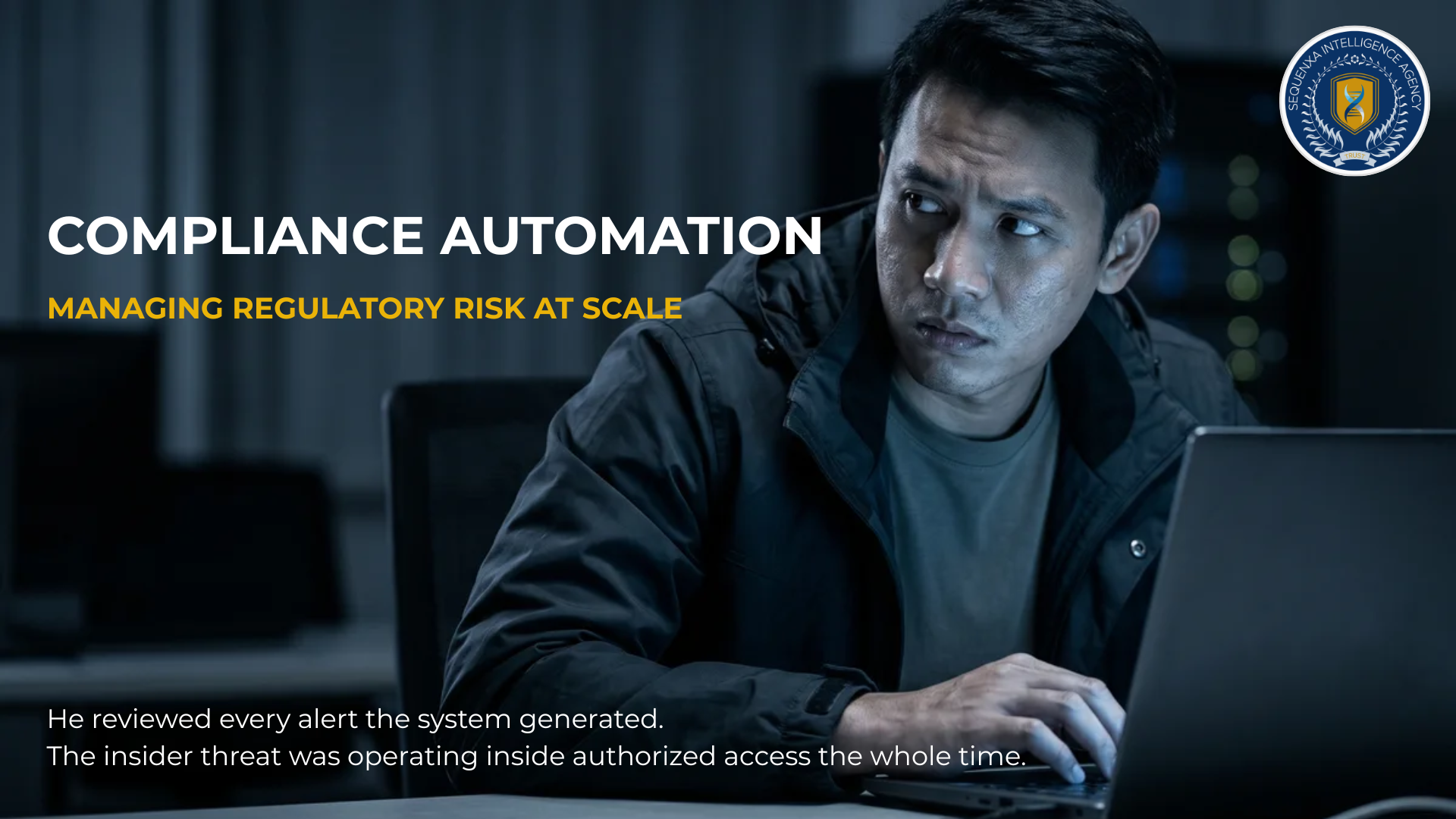
It does not detect insider threats operating within authorized access parameters. A user with legitimate credentials accessing data they are authorized to reach but should not be accessing for legitimate purposes will not trigger a rule-based compliance alert. (SureCloud, 2026; Swimlane, 2026)
It does not identify third-party vendor risks outside the monitored environment. Automated tools cover the systems they are integrated with. Supply chain risk, vendor security posture, and external access pathways require a different investigative approach.
It does not investigate after a violation has occurred. A compliance automation platform that flags a policy deviation is the beginning of an investigation, not the end of one. When the alert is a symptom of a deeper problem, automated tools have already reached their limit.
For organizations that need investigation capability beyond what automated compliance monitoring can reach, including access history forensics, insider threat review, third-party risk assessment, and regulatory incident scoping, our Corporate Intelligence team supports the investigation process that starts where the automation stops.
Frequently Asked Questions
What is compliance automation?
The use of rule-based systems to continuously monitor, enforce, test, and report on an organization's adherence to regulatory and security policy requirements, replacing periodic manual audits with real-time automated checks.
What is database compliance automation?
The automated enforcement of access controls, configuration policies, change management rules, and audit logging within database environments, producing continuous compliance evidence for frameworks like HIPAA, PCI-DSS, and GDPR.
What does automated compliance monitoring do?
It continuously checks systems against defined policy baselines and generates real-time alerts when configurations drift, access controls change, or policy violations occur.
What is automated compliance reporting?
It pulls data from integrated systems, applies framework-specific reporting rules, and produces standardized documentation ready for auditor review, reducing audit preparation from weeks to hours.
What are compliance automation tools?
Software platforms that integrate with an organization's systems to automate policy monitoring, control testing, evidence collection, and compliance reporting across multiple regulatory frameworks.
What is a compliance automation platform?
A centralized system that manages compliance workflows across frameworks, automates evidence collection, generates audit-ready reports, and provides continuous monitoring of control status.
What is security compliance automation?
The application of compliance automation within IT and information security programs, covering access controls, configuration management, vulnerability status, data handling, and audit logging.
References
Centraleyes. (2024). Best Compliance Automation Tools. Retrieved from https://www.centraleyes.com
Cynomi. (2025). Compliance Automation Tools. Retrieved from https://cynomi.com
DBmaestro. (2026). Database Security and Compliance Automation. Retrieved from https://www.dbmaestro.com
DBWatch. (2025). Database Security and Compliance Overview. Retrieved from https://www.dbwatch.com
Linford. (2025). Compliance Automation Tools: A Guide to Regulatory Success. Retrieved from https://linfordco.com
Liquibase. (n.d.). Database Compliance: Stronger and Simpler with CI/CD Automation. Retrieved from https://www.liquibase.com
Lucid.now. (2025). How Automated Reporting Simplifies Compliance. Retrieved from https://www.lucid.now
Qarma. (n.d.). Automated Compliance Reporting. Retrieved from https://www.qarmainspect.com
Sprinto. (2026). Compliance Automation Guide: Steps to Save Time and Reduce Risk. Retrieved from https://sprinto.com
SureCloud. (2026). Compliance Automation and Data Security: What Actually Works. Retrieved from https://www.surecloud.com
Swimlane. (2026). How Compliance Automation Enhances Data Security. Retrieved from https://swimlane.com
Zluri. (2026). Top 13 Compliance Automation Tools in 2026. Retrieved from https://www.zluri.com