
Sequenxa Intelligence
[ Intelligence ]Deleted Browser History: How Digital Forensics Recovers It
An in-depth look at how deleted browser history persists through system artifacts, DNS logs, and how digital forensics reconstructs browsing activity timelines.
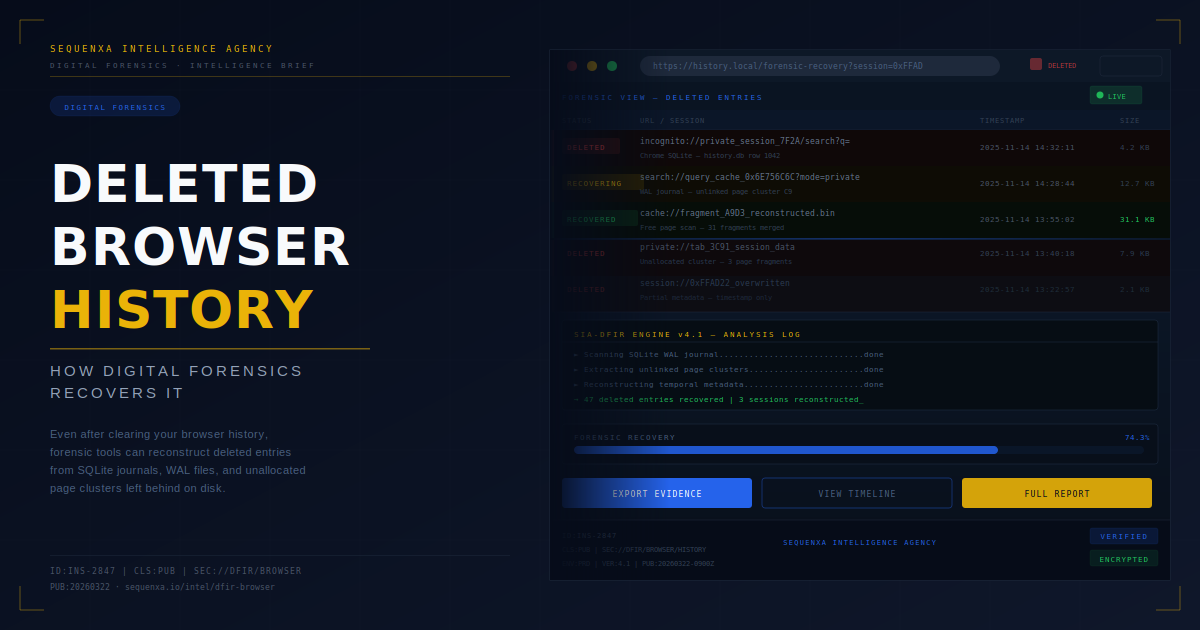
Clearing browser history removes the visible record. It doesn't erase the forensic one. In digital forensics, this misconception defines how both the public and institutions misunderstand privacy.
Browsers, Google Chrome, Microsoft Edge, Mozilla Firefox, Safari, all rely on local databases, cached media, and DNS interactions that generate durable traces of user activity. Deleting these records merely hides them from view; they linger inside filesystem artifacts and network-level logs.
What Deleted Browser History Actually Is
Deleted browser history continues to exist in residual system files and cached metadata.
• Browser storage architecture: Browsers store visit logs within SQLite databases (e.g., History.db), while cookies and cache files maintain authentication and session data (Mozilla Developer Network, 2025).
• Deletion mechanics: Clicking "Clear History" flags disk clusters as available for reuse; it doesn't overwrite data immediately (SANS Institute, 2024).
• Residual artifacts: Local remnants include thumbnail caches, prefetch files, and cloud sync records connected to user accounts such as Google Sync or Apple iCloud.
• Network persistence: Even after device-level cleanup, Domain Name System (DNS) caches, ISP logs, or enterprise proxy records can still reconstruct timelines.
Absence from view is not evidence of nonexistence. Forensic environments treat deleted data as latent evidence, not as lost information (FBI Digital Forensics Lab, 2024).
Mac & iOS Forensic Analyst, warns: "Deleting Safari history doesn't actually delete it from the database. The records are marked as deleted but remain recoverable until overwritten."
Why Standard Recovery Falls Short
Consumer-level recovery and IT audits can't replicate the precision of forensic reconstruction.
Limitations of conventional recovery:
• Consumer tools retrieve partial records from index fragments but lack forensic metadata integrity.
• IT department reviews rarely establish a chain of custody, a principle critical for legal admissibility (NIST SP 800-86, 2024).
• Manual screenshot documentation or log exports provide visibility but not verifiability (SANS Institute, 2024).
When deletion is deliberate, superficial tools reveal only the act of clearing, not the intent behind it. Digital forensics bridges that gap by reconstructing narrative integrity (Magnet Forensics, 2025).
Digital Forensics Expert & Author, states: "Non-forensic tools change the evidence. Every time you run a recovery program without imaging first, you're potentially destroying what you need to prove in court."
How Digital Forensics Recovers Deleted Browser Evidence

Digital forensics operates through structured investigative stages that ensure both completeness and legal integrity.
1. Forensic Imaging - Analysts create a bit-for-bit copy of the storage medium before alteration. This snapshot preserves volatile evidence such as RAM and unallocated space (NIST SP 800-86, 2024).
2. File Carving and DB Reconstruction - Specialized forensic software (e.g., Autopsy, EnCase, Magnet AXIOM) rebuilds deleted SQLite tables to trace chronological browsing patterns (SANS Institute, 2024).
3. DNS and Router Log Analysis - Network-layer entities such as SOHO routers and enterprise firewalls log every outbound request even after local deletion (Cloudflare, 2025).
4. Cloud-Sync Correlation - Accounts tied to Google, Microsoft, or Apple ecosystems retain mirrored browser data across devices, offering a cross-device evidence chain (Google Cloud Security, 2025).
5. Metadata Correlation and Timeline Mapping - Combining file timestamps, user session logs, and activity monitors yields a consolidated activity narrative (FBI Digital Forensics Lab, 2024).
Outcome: A forensically sound evidence package documenting data origin, chain of custody, and timeline reconstruction - admissible in internal investigations and civil or criminal courts (NIST SP 800-86, 2024).
Digital Evidence Specialist, explains: "File carving recovers data from unallocated space where deleted browser records live. This technique reconstructs what users thought was gone forever."
Strategic and Legal Implications
In a contested information environment, control of data reconstruction equals control of narrative legitimacy. Digital evidence becomes a strategic weapon, not just a compliance necessity.
Use-case spectrum:
• Corporate misconduct investigations: A cleared browser may still reveal data exfiltration routes through forensic DNS comparison.
• Legal discovery: Immediate imaging ensures preservation once a litigation hold is issued.
• Insider threat analysis: Forensic browser reconstruction verifies whether confidential uploads occurred to third-party platforms like Dropbox, WeTransfer, or Google Drive.
Decision threshold:
• If digital evidence could influence HR, legal, or compliance outcomes, forensic preservation must precede any recovery attempt.
• Each system operation post-deletion reduces artifact recoverability exponentially.
• Every keystroke after deletion rewrites the probability landscape of forensic retrieval.
Android Forensics Researcher, observes: "The first person to touch a device after a crime often destroys the evidence. Proper forensics prevents that single point of failure."
Digital Sovereignty and Truth Reconstruction
The struggle over browser history reflects a larger social tension, the illusion of digital erasure.
Governments champion data privacy laws like GDPR and CCPA, assuring users that they can control digital visibility. Yet sovereignty doesn't equate to control; it equates to traceability (European Data Protection Board, 2025).
Forensic entities operate in that shadow: they don't decide public guilt or innocence but determine what can still be proven after the erasure attempt.
Social Engineering & Human Factors Expert, cautions: "People believe deleting history makes them invisible online. In reality, digital footprints persist across multiple layers most users never see."
Key Takeaways
• Deleting browser history hides data, not erases it.
• Forensic recovery uses imaging, carving, and cloud sync correlation to rebuild timelines.
• Consumer tools lack evidentiary credibility and chain-of-custody safeguards.
• Organizational decision-makers should initiate forensic preservation before any recovery.
• In the broader discourse, digital forensics underpins digital sovereignty, defining who controls factual truth in contested environments.
FAQs
How to access deleted web history?
Professional forensic tools analyze unallocated disk space and DNS caches. Consumer apps only retrieve fragments.
How do I check deleted history?
You must capture a forensic image before any new data rewrites deleted sectors.
How to recover deleted browsing history?
Forensic recovery reconstructs deleted SQLite records and matches them against DNS or cloud logs.
How to view deleted history?
Using forensic visualization software ensures timestamp accuracy and record integrity.
How to see deleted browsing history?
Through proper forensic methodology (imaging → carving → correlation), deleted browser trails can often be reconstructed entirely.
How to check deleted browsing history?
Only a certified forensic workflow guarantees non-contamination and admissibility.
How to see deleted history on Chrome?
Chrome's sync system replicates history across devices; forensic tools retrieve from both local storage and cloud synchronized logs.
How to find deleted browser history?
Residual traces live inside unallocated disk clusters, DNS logs, and synced user accounts.
How to retrieve internet history?
Network devices, ISPs, and enterprise proxies store connection logs long after local deletion.
How to recover history?
Through forensic imaging conducted before data is overwritten, enabling accurate timeline reconstruction.
The Forensic Window Never Stays Open
Deleted browser history leaves a forensic record, the question is whether it is recovered correctly and in time. Every minute after deletion narrows the recoverable evidence window as systems naturally overwrite unallocated space.
Organizations managing investigations where digital evidence may have been cleared should engage digital forensics before that window closes. The difference between suspicion and certainty often comes down to hours, not days.
Learn more about Sequenxa Digital Forensics.
References
Altheide, C. (2024). Android Forensics: First Response. SANS Institute. Retrieved from
https://www.sans.org/blog/android-forensics-first-response/
Carnegie Mellon Software Engineering Institute (SEI). (2024). Digital Forensics Tool Testing Reports. Retrieved from
https://resources.sei.cmu.edu/library/
Casey, E. (2025). Digital Evidence and Computer Crime. 4th Edition. Academic Press.
Cloudflare. (2025). DNS Analytics and Network Forensics Guide. Retrieved from
https://www.cloudflare.com/learning/dns/what-is-dns/
Edwards, S. (2024). Mac & iOS Forensic Analysis Report: Safari History Persistence. Mac4n6. Retrieved from
European Data Protection Board (EDPB). (2025). GDPR Enforcement Trends: Data Retention and Deletion. Retrieved from
FBI Digital Forensics Lab. (2024). Mobile and Browser Artifact Recovery Techniques. Retrieved from
https://www.fbi.gov/services/laboratory/digital-forensics
Google Cloud Security. (2025). Browser Sync and Forensic Implications. Retrieved from
https://cloud.google.com/security
Hadnagy, C. (2025). Social Engineering: The Science of Human Hacking. Wiley.
Magnet Forensics. (2025). AXIOM Browser Artifact Recovery Whitepaper. Retrieved from
https://www.magnetforensics.com/resources/
Mozilla Developer Network (MDN). (2025). Browser Storage APIs and SQLite Implementation. Retrieved from
https://developer.mozilla.org/en-US/docs/Web/API
National Institute of Standards and Technology (NIST). (2024). SP 800-86: Guide to Integrating Forensic Techniques into Incident Response. Retrieved from
https://nvlpubs.nist.gov/nistpubs/Legacy/SP/nistspecialpublication800-86.pdf
Shavers, B. (2024). Hiding Behind the Keyboard: Digital Forensics in a Post-Truth World. Syngress.
SANS Institute. (2024). FOR508: Advanced Incident Response and Threat Hunting. Retrieved from
https://www.sans.org/cyber-security-courses/advanced-incident-response-threat-hunting/