
Sequenxa Intelligence
[ Intelligence ]Lawful Presence: What It Means and What Organizations Miss
Rejecting a legally sufficient document is an unfair documentary practice under federal law. Here's what lawful presence verification requires in practice.
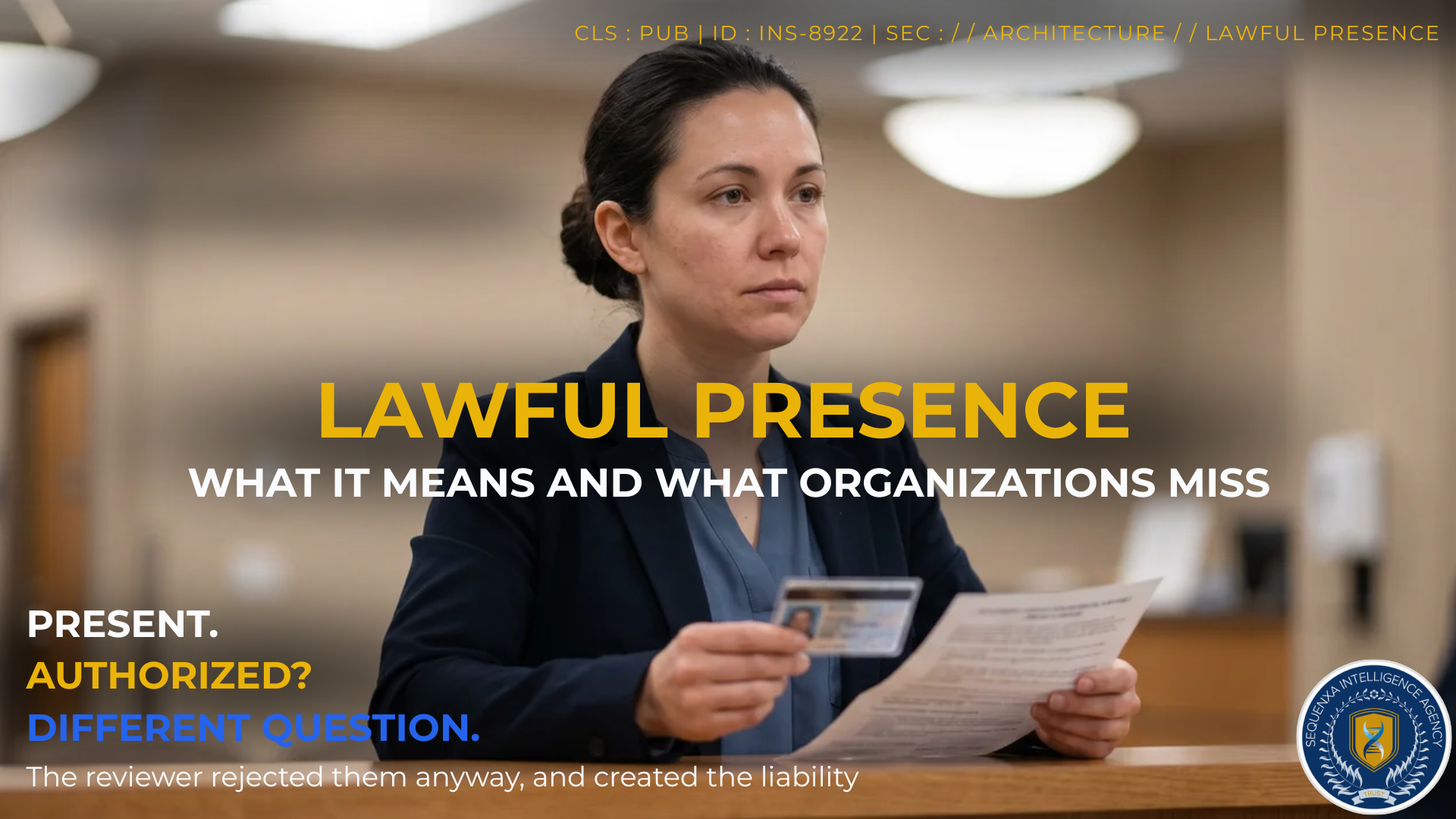
Lawful presence is the federal standard that determines whether a person is legally authorized to be in the United States, as a citizen, permanent resident, or non-citizen authorized to remain under a specific visa category or immigration status. For organizations, it is not an abstract immigration concept. It is the identity layer that underpins I-9 employment eligibility verification, REAL ID document acceptance, state benefit eligibility, and a growing range of professional licensing requirements.
The organizational risk is not in misunderstanding the definition. It is in treating lawful presence verification as a document collection function rather than a compliance workflow, and discovering the difference after a DHS audit, a wrongful termination claim, or a Form I-9 inspection.
What Is Lawful Presence
Lawful presence means a person is legally authorized to be in the United States under federal immigration law, either as a U.S. citizen, a lawful permanent resident, or a non-citizen present under a valid visa, immigration status, or federal authorization.
Legal presence carries the same meaning across most state-level contexts, DMV licensing, state benefit eligibility, professional licensing, and public university enrollment. In each context, the determination is the same: is this person physically and legally authorized to be in the United States in a recognized status at the time of the transaction?
Two terms that organizations frequently conflate, and should not:
Lawful presence is the broader determination. It includes people with formal lawful status and people who are legally present under a federal authorization that does not confer formal status, such as individuals with deferred action, pending adjustment of status, or Temporary Protected Status.
Lawful status is the narrower formal classification assigned by USCIS or the State Department, H-1B, F-1, LPR, U.S. citizen. A person can be lawfully present without holding a formal lawful status category.
Work authorization is distinct from both. It is the specific determination that a person is authorized to accept employment in the United States, which derives from lawful presence and status but is not identical to either. An F-1 student is lawfully present and holds lawful status but is generally not work-authorized without Optional Practical Training approval. A DACA recipient is lawfully present and work-authorized with an Employment Authorization Document but does not hold lawful status.
Organizations that conflate these three categories create two simultaneous compliance risks: accepting documents that do not establish the correct authorization category, and rejecting documents that are legally sufficient, the latter of which constitutes an unfair documentary practice under 8 U.S.C. § 1324b.
Lawful Presence vs. Lawful Status
The practical difference for organizations running employment eligibility verification is this: the I-9 process does not ask employees to prove lawful status. It asks them to prove identity and work authorization, two functions that may be established by a single document or by two separate documents depending on the employee's status category.
The table below reflects how the three categories align across common status types:
This distinction is operationally significant during re-verification. An employee whose F-1 status has expired but whose OPT authorization is current remains work-authorized, rejecting their continued employment based on the status expiration rather than the authorization document is an I-9 compliance error.
Lawful Presence Documents
The documents that prove lawful presence differ by status category. Organizations must accept any document from the I-9 List A, B, or C that facially establishes the required authorization, they cannot specify which document an employee must present.

U.S. Citizens:
• U.S. passport or passport card
• Certified U.S. birth certificate issued by a state office of vital statistics (with raised seal)
• Certificate of Naturalization (Form N-550 or N-570)
• Certificate of U.S. Citizenship (Form N-560 or N-561)
• Consular Report of Birth Abroad issued by the U.S. Department of State
Lawful Permanent Residents:
• Permanent Resident Card (Form I-551 / Green Card)
• Foreign passport with a temporary I-551 stamp or printed notation
Non-Immigrant Visa Holders:
• Foreign passport with valid visa and most recent Form I-94 showing authorized period of stay
• Employment Authorization Card (Form I-766) for work-authorized categories
• Form I-797 approval or receipt notice for pending status extensions during the grace period
DACA and Deferred Action Holders:
• Employment Authorization Card (Form I-766)
• Form I-797 approval notice
• Note: deferred action confers lawful presence for specific federal purposes but not lawful status, the EAD is the operative work authorization document, not the underlying DACA approval
Proof of legal presence and proof of lawful presence refer to the same function across different institutional contexts, the document or document combination that satisfies the requesting agency's verification requirement. For DMV purposes, proof of U.S. citizenship or lawful presence must be established through a state-specific document list. For I-9 purposes, the acceptable document list is federally standardized.
Legal Presence and the DMV - REAL ID
DMV legal presence requirements derive directly from the REAL ID Act of 2005, which conditions the issuance of federally compliant driver's licenses and ID cards on verification of the applicant's lawful presence. A REAL ID-compliant license or ID carries a star marking in the upper corner, indicating the issuing state confirmed lawful presence through DHS SAVE or document review before issuance.
The legal presence unit DMV, referenced across Virginia, Texas, and several other states, is the dedicated review unit within the state DMV responsible for resolving lawful presence documentation that cannot be verified electronically. When the DHS SAVE system cannot confirm an applicant's status from the documents presented, the case is referred to the legal presence unit for manual review. The unit contacts DHS directly, requests additional verification, or requires the applicant to provide supplementary documentation before the license or ID is issued.
What does it mean when lawful presence verification is complete? In DMV and state agency contexts, this status means the system or reviewer has confirmed the applicant's status is valid and the transaction, license issuance, benefit enrollment, university registration, can proceed. The verification resolved without requiring further documentation or escalation.
For organizations: REAL ID-compliant licenses and IDs carry weight in two I-9 contexts. As a List B identity document, a REAL ID-compliant license reflects that the holder's lawful presence was already verified by the issuing state, a relevant factor when assessing document authenticity. For access control programs that require federally compliant ID for facility entry, REAL ID compliance is the minimum standard.
When Verification Does Not Confirm
This is where organizational compliance obligation extends beyond document collection. Three scenarios require a defined workflow rather than a binary accept-or-reject decision.
DHS SAVE or E-Verify non-confirmation. When the system returns a Tentative Non-Confirmation (TNC) for a newly hired employee, the organization must follow a federally defined process, provide the employee with written notice, allow them to contest the result directly with DHS within eight federal government working days, and maintain the employment relationship during the contest period. Terminating or suspending an employee based on a TNC before it becomes a Final Non-Confirmation is an unfair employment practice under federal law, regardless of the organization's intent.
Document fraud indicators. Visual inspection of I-9 documents is legally required but insufficient as a standalone authentication control. Common indicators that warrant closer review: biographical data that does not match across documents, issue and expiration dates that fall outside the document type's valid range, format inconsistencies against the current version of the document, and identity documents that do not match the physical appearance of the person presenting them. Organizations that flag these indicators must handle them through a consistent, non-discriminatory review process, applying the same standard to all employees regardless of national origin or citizenship status.
Re-verification for time-limited status. Employees whose lawful presence and work authorization is time-limited, H-1B holders, TN visa holders, EAD card holders, OPT participants, require I-9 re-verification before their authorization document expires. Organizations without a calendar-based tracking system for authorization expiration routinely discover expired work authorizations during audits rather than before, creating retroactive I-9 exposure that cannot be remediated after the fact.
Organizational Verification Workflow
The organizational verification workflow for lawful presence operates in three layers that most compliance programs do not fully separate.

Layer 1 - Document collection and visual review. Required for all employees at hire. The I-9 examiner reviews original documents, confirms they are on the applicable List, and records document information. This layer establishes the baseline and is the legal minimum for all employers.
Layer 2 - Electronic verification. E-Verify cross-references the documents against DHS and SSA records. For federal contractors and in E-Verify mandatory states, this layer is legally required. For other employers, it is optional but provides a fraud detection mechanism that visual review cannot replicate.
Layer 3 - Authentication review. For documents where fraud indicators are present or where electronic verification returns a non-confirmation, authentication review assesses the document's physical characteristics against known standards, security features, format specifications, and biographical data consistency. This layer sits outside the standard I-9 workflow and requires specialized capability.
Organizations that operate only Layer 1 are legally compliant for most routine hires, but carry unresolved exposure for fraudulent documents that pass visual inspection and are never submitted for electronic verification.
When a verification result requires resolution beyond standard administrative channels, or when document authenticity is in question, our verification team can support the review. When a workforce compliance issue involves suspected identity fraud, fabricated credentials, or systematic document misrepresentation, corporate investigations provide the forensic review that administrative re-verification cannot.
Frequently Asked Questions
What is lawful presence?
Lawful presence is the federal determination that a person is legally authorized to be in the United States, as a U.S. citizen, lawful permanent resident, or non-citizen present under a valid visa, immigration status, or federal authorization.
What does it mean when lawful presence verification is complete?
It means the issuing agency, DMV, state benefits office, or university, has confirmed through DHS SAVE or document review that the applicant's status is valid and the transaction can proceed without further documentation.
What is the difference between lawful presence and lawful status?
Lawful status is the formal immigration classification assigned by USCIS or the State Department. Lawful presence is broader, it includes people with formal lawful status and those present under federal authorizations that do not confer formal status, such as deferred action.
What documents prove lawful presence?
For U.S. citizens: passport, birth certificate, certificate of naturalization. For lawful permanent residents: Green Card (I-551). For visa holders: foreign passport with I-94 and valid visa, or Employment Authorization Card. Required documents vary by context, I-9 uses a federally standardized list; DMV uses a state-specific list.
What is the DMV legal presence unit?
The state DMV review unit that handles lawful presence documentation that cannot be verified electronically through DHS SAVE, conducting manual review, requesting supplementary documents, or coordinating directly with DHS to resolve the applicant's status.
What is proof of legal presence?
The document or document combination that establishes an individual's lawful authorization to be in the United States for a specific institutional purpose, driver's license issuance, benefit enrollment, employment, or professional licensing. Required documents differ by the requesting institution and the applicant's status category.
What is verification of lawful presence status?
The institutional process, through DHS SAVE, E-Verify, or document review, by which an agency or employer confirms that a person's claimed immigration or citizenship status is valid before issuing a license, benefit, or employment authorization.
References
Law Insider. Lawful Presence Definition. https://www.lawinsider.com
American Immigration Council. (2019). What Is Lawful Presence and Why Does It Not Mean What It Sounds Like? https://www.americanimmigrationcouncil.org
Virginia DMV. Legal Presence Law. https://www.dmv.virginia.gov
DC DMV. REAL ID Proof of Lawful Presence. https://dmv.dc.gov
Texas DPS. U.S. Citizenship or Lawful Presence Requirement. https://www.dps.texas.gov
Nilan Johnson Lewis. (2026). Proof of Lawful Immigration Status: What to Carry. https://nilanjohnson.com
Stride Health. What Documentation Can I Submit for Proof of Lawful Presence? https://support.stridehealth.com
Middle Georgia State University. Lawful Presence Documentation. https://www.mga.edu