
Sequenxa Intelligence
[ Intelligence ]SolarWinds: The Governance Failure Behind the Breach
A case study in control failure, disclosure risk, and the collapse of "trust us" security.
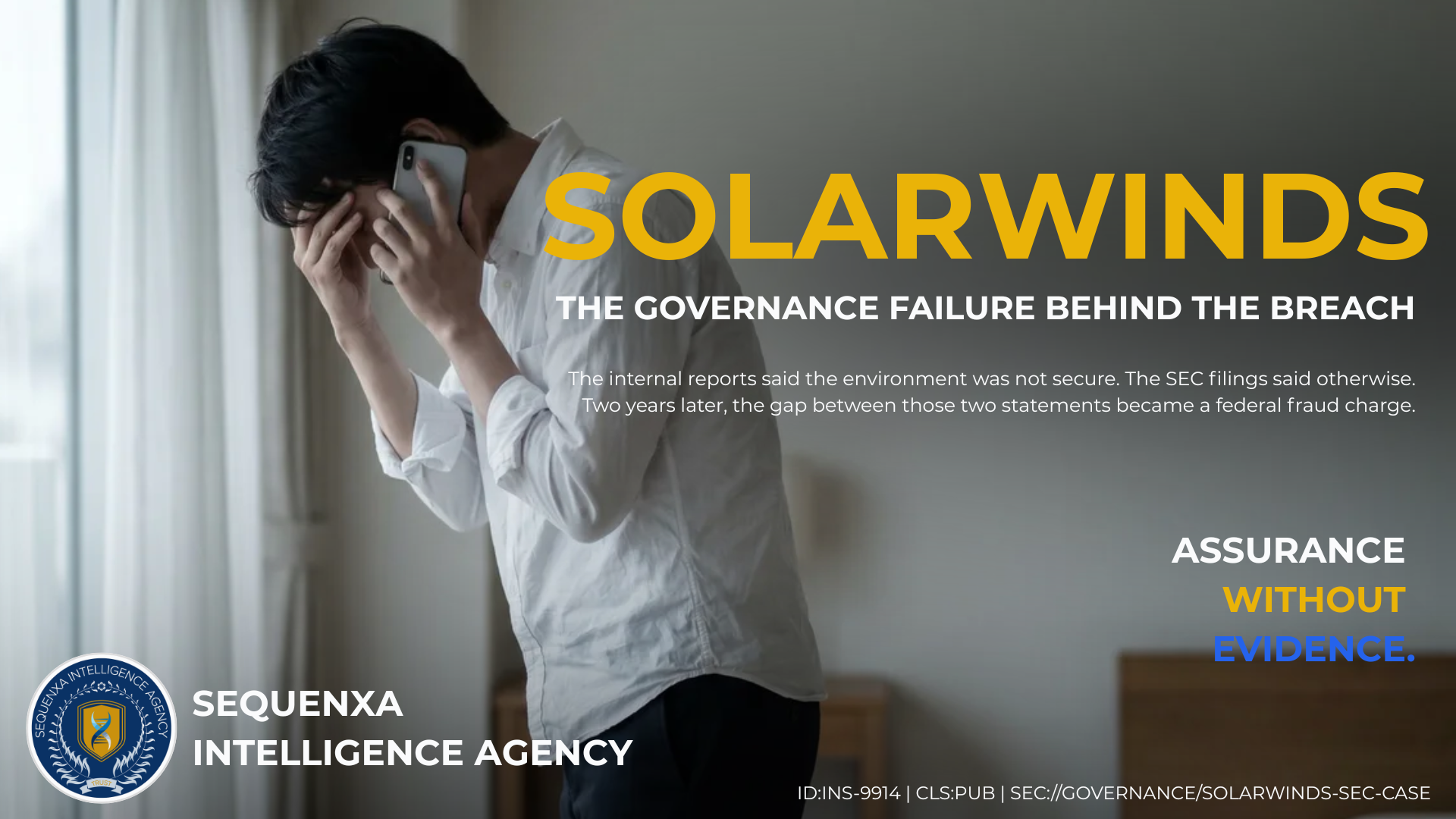
A case study in control failure, disclosure risk, and the collapse of "trust us" security.
What Happened?
In October 2023, the U.S. Securities and Exchange Commission charged SolarWinds Corporation and its Chief Information Security Officer with fraud and internal control failures. The complaint revealed a two-year gap between what the company told investors about its cybersecurity posture and what it knew internally.
From 2018 to 2020, SolarWinds portrayed its cyber controls as mature and resilient while internal communications described the environment as "not very secure," "inappropriately privileged," and "not resilient." That disconnect between assurance and evidence became the basis of enforcement.
Public filings described cybersecurity risks as hypothetical. Internal documents detailed known vulnerabilities in the company's flagship platform. A 2018 internal report warned that remote access settings were insecure enough for attackers to operate without detection. By 2019, a security presentation stated that the current state of security left critical assets in a vulnerable condition. By 2020, engineers acknowledged that security issues had outstripped the capacity of the engineering team to resolve them.
When the breach became public in December 2020, the company's stock dropped 35% within weeks. The SEC concluded that SolarWinds had painted a false picture of its cyber controls environment.
How It Happened?
SolarWinds did not fail because it was hacked. It failed because it could not prove what it claimed.
This was not a technical failure. It was a governance one. The company lacked a verifiable system to identify, escalate, and resolve risk at the control layer. There was no immutable audit trail showing how vulnerabilities were managed, no verifiable record of internal assurances, and no automated linkage between operational risk data and SEC disclosures. SolarWinds could report security. It could not prove it.
For public companies operating under current enforcement standards, reasonable assurance is no longer a narrative. It is an evidence chain. Transparency must be enforced by architecture, not by the judgment of individuals.

A defensible environment requires:
• Immutable audit logs: records that cannot be altered after the fact by anyone in the organization.
• Verifiable risk lineage: every vulnerability traceable from discovery through escalation to disclosure.
• Controlled disclosure workflows: compliance officers and engineers working from the same verified data.
• Identity-bound accountability: documented proof of who knew what, when, and what action followed.
Without these elements, trust becomes conjecture. Conjecture has no evidentiary value in an SEC proceeding.
How It Could Have Been Prevented?
The control gaps that turned SolarWinds from a security incident into a governance crisis were not inevitable. They were structural, and each one had a preventable architecture. Internal warnings ignored.
Critical alerts and internal presentations lost context over time, isolated in emails, detached from slides, with no continuous record of what was known and when. An immutable documentation chain would have captured each signal as evidence, preserving authorship, timestamp, and escalation path. The question "who knew?" would have had a verifiable answer.
Incomplete investor disclosures.
What engineers documented internally never reached the same truth expressed externally. Provenance-driven disclosure workflows that link internal risk evidence directly to investor-facing statements would have ensured that disclosures reflected documented facts rather than curated narratives. Transparency becomes automatic, not optional.
Privilege mismanagement.
Administrative access remained excessive and unverified, leaving critical systems open to abuse without detection. An identity-bound audit layer that ties every privileged action to a verified human identity closes that gap. Privilege becomes observable and accountable, not assumed.
Engineering overload.
The backlog of unresolved vulnerabilities outpaced the organization's ability to track or justify them. With tamper-proof workflow visibility, leadership and regulators could have seen in real time what was identified, what was deferred, and what was ignored. That eliminates hindsight as an excuse and demonstrates operational integrity under strain.
With cryptographic provenance in place, SolarWinds' executives would have faced transparency requirements at the time decisions were made, not litigation after the fact.
The Governance Lesson
The SEC's action against SolarWinds marks a shift in how cyber risk is classified. It is now a disclosure liability. When security assurance is expressed without supporting evidence, it becomes a governance exposure. Companies that cannot produce verifiable proof of internal control integrity are not only vulnerable to attackers. They are vulnerable to regulators.
In high-trust sectors including defense, government, and regulated enterprise, defensibility is no longer an IT metric. It is a financial control. The ability to prove assurance has become a measure of credibility in capital markets. Investors no longer reward confidence. They reward evidence.
For organizations that need to assess whether their current control documentation, risk escalation records, and disclosure workflows would hold up under regulatory scrutiny, our Corporate Intelligence Services team supports internal control review and governance gap assessment. Organizations operating in regulated sectors can also review our due diligence investigations capability for third-party and supply chain risk verification, and our predictive threat intelligence division for continuous risk monitoring that produces verifiable evidence rather than periodic assurances.
Takeaway
SolarWinds did not fail because it was breached. It failed because it could not prove what it claimed. In a market where assurance defines enterprise value, provenance replaces promises and integrity replaces intent.
Future enforcement will not focus solely on whether a company was compromised. It will focus on whether the company can demonstrate that its assurances were true at the time they were made.