
Sequenxa Intelligence
[ Intelligence ]What AI Compliance Actually Requires Under EU AI Act 2025?
The EU AI Act entered full enforcement in 2025, creating binding obligations for high-risk AI systems across financial services, healthcare, critical infrastructure, and employment, with fines up to 3% of global annual turnover for non-compliance. (EU AI Act, 2024) At the same time, 78% of enterprise security leaders report that AI adoption has outpaced their organization's ability to govern it.
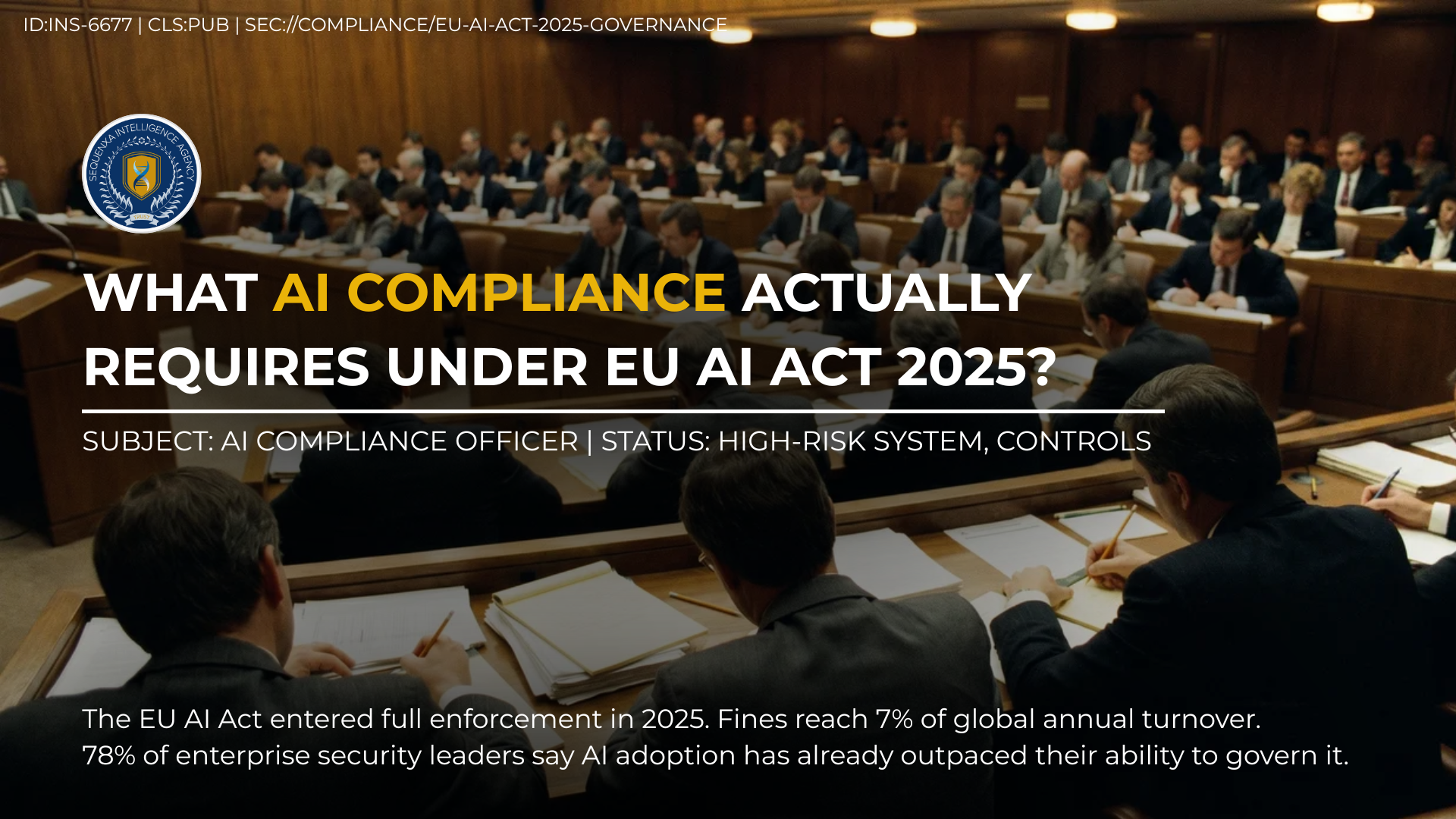
The EU AI Act entered full enforcement in 2025, creating binding obligations for high-risk AI systems across financial services, healthcare, critical infrastructure, and employment, with fines up to 3% of global annual turnover for non-compliance. (EU AI Act, 2024) At the same time, 78% of enterprise security leaders report that AI adoption has outpaced their organization's ability to govern it. (NICE, 2026)
The gap between AI deployment and AI governance is a structural one. Organizations that treat AI compliance as a documentation and tooling exercise will build programs that satisfy auditors while leaving the actual risk surface unverified.
What Is AI Compliance?
AI compliance is the process of ensuring AI systems adhere to applicable laws, internal policies, and industry standards throughout their lifecycle, from development through deployment and ongoing monitoring. (Blue Prism, 2025)
It is not a single framework. It spans GDPR automated decision-making requirements, the EU AI Act's risk classification tiers, NIST AI RMF, sector-specific obligations such as FFIEC for financial services and HIPAA for health AI, and a growing body of national AI governance standards that are still being finalized. Core obligations for high-risk AI systems include transparency and explainability of decisions, auditability and traceability, human oversight mechanisms, documentation and evidence retention, and regulatory incident reporting. (NICE, 2026)
The compliance surface is not static. The EU AI Act is phased through 2026, NIST AI RMF guidance is being updated, and national regulators continue issuing interpretations that have not yet settled into stable requirements. Organizations that build AI compliance programs against currently enacted regulation without building for regulatory change will find their programs outdated before the next audit cycle. (Regology, 2026)
What Multi-Cloud AI Environments Introduce
Multi-cloud AI deployments distribute workloads, data, and model inference across multiple cloud providers, creating identity and access management fragmentation, configuration drift, and expanded attack surfaces that single-cloud governance frameworks do not address. (IJSET, 2026)
The specific risks are architectural. IAM policies enforced in one cloud environment may not be consistently applied in another. Data encryption standards vary between providers. Configuration drift across environments creates compliance gaps that automated monitoring flags only after the fact. Inter-cloud connectivity introduces network attack surfaces that perimeter controls do not reach. (Mad Devs, 2025) (Upwind, 2025)
Automation compounds these risks. An automated workflow that propagates a policy misconfiguration across three cloud environments does so at machine speed, the blast radius of a single error is immediate and organization-wide. (CSA, 2026) Consistent IAM policy enforcement, least privilege access, and just-in-time authentication are the foundational controls, but they require architectural implementation, not policy documentation.
What a Defensible AI Governance Program Requires
Six components that a verified AI governance program must have in place:
 AI system inventory. Every AI model in production, including third-party and vendor AI embedded in enterprise tools, mapped against applicable regulatory classifications. (Legit Security, 2026) Organizations that do not know what AI they are running cannot govern it.
Risk classification. High-risk AI systems identified and documented under EU AI Act criteria, with controls matched to the appropriate risk tier. (Compliance Solutions, 2025) A risk classification that exists only in documentation and has not been verified against actual system behavior is not a risk classification, it is an assumption.
Audit trail and traceability. Every significant AI decision logged with the model version, input data, output, and human review status, meeting GDPR Article 22 and EU AI Act transparency requirements. (NICE, 2026) Logging the output without logging the input and the model state that produced it does not satisfy traceability requirements.
Continuous monitoring. Real-time detection of model drift, data quality degradation, and compliance configuration changes, not periodic reviews that produce a point-in-time snapshot of an environment that changes continuously. (Sprinto, 2026)
Human oversight mechanisms. Defined escalation paths for AI decisions that exceed confidence thresholds or trigger regulatory review criteria. (Blue Prism, 2025) Human oversight that exists in a policy document but has no operational trigger is not a control, it is a statement of intent.
Regulatory change monitoring. Automated tracking of applicable regulatory updates across relevant jurisdictions, because the frameworks governing AI are still being actively developed. (Regology, 2026)
Where AI Compliance Programs Fail
Four failure patterns that appear consistently in enterprise AI governance programs that look complete on paper:

Shadow AI. Business units deploy AI models outside IT governance, in productivity tools, customer-facing applications, and internal automation workflows, creating compliance exposure the enterprise AI program cannot see. (BuildMVPFast, 2026) A governance program that covers sanctioned AI while shadow AI operates outside its scope has an inventory gap that no amount of documentation closes.
Third-party AI risk. Vendor AI systems embedded in enterprise products carry their own compliance obligations. Organizations that do not inventory and assess vendor AI are inheriting regulatory risk they have not documented, and cannot disclose, remediate, or defend against because they do not know it exists. (Legit Security, 2026)
Audit trail gaps. AI decisions logged at the output level but not traceable to the input data, model version, or human review status cannot satisfy transparency and explainability requirements under GDPR or the EU AI Act. (NICE, 2026) Regulators examining AI decision-making in an enforcement context will ask for the full trace, not the summary.
Unverified controls. Compliance programs that document AI governance controls without independently testing whether those controls hold produce a clean audit report for a system that has not been verified under adversarial conditions. (Resolver, 2026) The distinction between documented controls and verified controls is the same distinction that creates enforcement exposure, and it is widening as AI-specific regulations move from guidance to enforcement.
"An AI compliance program that has never been tested under adversarial conditions has not confirmed its own integrity. It has confirmed its own documentation."
Validated AI Compliance vs. Documented AI Compliance
The same distinction that applies to standard compliance automation applies to AI governance: documentation confirms design intent, adversarial testing confirms whether the design holds under pressure.
AI systems introduce attack vectors that traditional penetration testing frameworks do not cover. Model inversion attacks extract training data from deployed models. Prompt injection manipulates AI outputs by embedding instructions in user inputs. Adversarial inputs cause AI systems to misclassify data in ways that are invisible to standard monitoring. Data poisoning corrupts model behavior at the training layer. Model extraction allows adversaries to replicate proprietary AI systems through repeated queries.
A compliance program that has never been tested against these vectors has not confirmed its own integrity. It has confirmed its own documentation.
Red team exercises that include AI-specific attack scenarios close that gap, converting a documented AI governance program into a verified one. Organizations operating high-risk AI systems under the EU AI Act or sector-specific regulation cannot rely on internal audit as the sole validation mechanism. Independent adversarial testing is the standard that holds under enforcement scrutiny, not the standard that satisfies an internal checklist.
The regulatory trajectory reinforces this. As the EU AI Act enforcement apparatus matures and national regulators develop their own AI oversight capabilities, the question they will ask is not whether an organization has an AI governance program. It is whether that program has been independently verified, and whether the verification evidence is documented, traceable, and current.
The Governance
AI compliance and multi-cloud security are architecture problems before they are documentation problems. Organizations that build governance programs without verifying whether those programs hold under adversarial conditions are producing assurance at the documentation layer while leaving the actual risk surface untested.
 For organizations that need to verify whether their AI governance controls and multi-cloud security architecture hold under adversarial conditions, offensive security assessments test the controls AI compliance programs are built around, producing verified findings rather than policy confirmations.
Red team services extend that validation to AI-specific attack scenarios, including prompt injection, model extraction, and adversarial input testing that standard penetration testing does not cover.
Frequently Asked Questions
What is AI compliance automation?
AI compliance automation is the use of technology to continuously monitor AI systems, enforce governance policies, generate audit trails, and track regulatory requirements without manual intervention, reducing the operational burden of maintaining compliance across AI-enabled enterprise environments. (Blue Prism, 2025)
What is the EU AI Act and who does it apply to?
The EU AI Act is the EU's binding regulation for AI systems, classifying AI by risk tier and imposing obligations on developers and deployers of high-risk AI. It applies to organizations that develop, deploy, or use AI systems in the EU regardless of where those organizations are headquartered. Full enforcement began in 2025. (EU AI Act, 2024)
What is enterprise AI governance?
Enterprise AI governance is the organizational framework, policies, controls, oversight structures, and monitoring processes, that ensures AI systems operate within applicable legal, ethical, and operational boundaries throughout their lifecycle. (Legit Security, 2026)
What makes multi-cloud AI environments difficult to secure?
IAM fragmentation across providers, configuration drift between environments, inconsistent encryption standards, and inter-cloud connectivity create attack surfaces that single-cloud security frameworks were not designed to address. Automation amplifies these risks by propagating misconfigurations at machine speed. (Mad Devs, 2025) (Upwind, 2025)
Does AI compliance replace penetration testing?
No. AI compliance governance confirms that controls are designed and documented correctly. Penetration testing and red team exercises confirm whether those controls hold under adversarial conditions. Both are required, AI systems introduce attack vectors that compliance frameworks document but do not test. (Resolver, 2026)
References
Blue Prism. (2025). AI Compliance Best Practices. Retrieved from https://www.blueprism.com
BuildMVPFast. (2026). 10 Best AI Compliance and Security Tools for Enterprises. Retrieved from https://www.buildmvpfast.com
Cloud Security Alliance. (2026). Securing Multi-Cloud Workloads: 5 Best Practices. Retrieved from https://cloudsecurityalliance.org
Compliance Solutions. (2025). Persistent AI Compliance. Retrieved from https://www.compliancesolutions.com
EU AI Act. (2024). Regulation on Artificial Intelligence. Retrieved from https://eur-lex.europa.eu
IJSET. (2026). Secure and Automated Enterprise Platforms in Multi-Cloud Environments. Retrieved from https://www.ijset.in
Legit Security. (2026). 8 AI Governance Platforms for Easier Compliance in AI Systems. Retrieved from https://www.legitsecurity.com
Mad Devs. (2025). Multi-Cloud Security Strategies and Best Practices. Retrieved from https://maddevs.io
NICE. (2026). Enterprise AI Security and Compliance: Essential Strategies. Retrieved from https://www.nice.com
Regology. (2026). Global Regulatory Compliance Platform Powered by AI. Retrieved from https://regology.com
Resolver. (2026). How AI in Compliance Boosts Efficiency and Accuracy. Retrieved from https://www.resolver.com
Sprinto. (2026). 5 AI Compliance Companies You Must Know in 2026. Retrieved from https://sprinto.com
Tonic.ai. (2025). AI Compliance: How to Implement Compliant AI. Retrieved from https://www.tonic.ai
Upwind. (2025). Secure Your Multi-Cloud Environment. Retrieved from https://www.upwind.io