
Sequenxa Intelligence
[ Intelligence ]What Is a Compliance Management System? The Seven Components
Regulatory enforcement actions do not typically target organizations with no compliance effort. They target organizations whose compliance programs looked complete on paper but failed operationally. The policies existed. The training was scheduled. The audits were conducted. What was missing was the structural integrity that turns documented compliance into functioning control, and the independent verification that would have confirmed whether that structure was actually working.
Regulatory enforcement actions do not typically target organizations with no compliance effort. They target organizations whose compliance programs looked complete on paper but failed operationally. The policies existed. The training was scheduled. The audits were conducted. What was missing was the structural integrity that turns documented compliance into functioning control, and the independent verification that would have confirmed whether that structure was actually working.
A compliance management system is the framework that closes that gap. Understanding what it includes, and where it breaks down, is the difference between a compliance program that protects an organization and one that creates the illusion of protection while leaving the actual exposure intact.
What Is Compliance Management?
Compliance management is the systematic process of identifying applicable regulatory requirements, assessing current practices against those requirements, implementing controls to close gaps, monitoring ongoing adherence, and reporting on compliance status continuously.
It is not a software platform, a policy document library, or an annual audit cycle. It is an integrated framework of processes, controls, accountability structures, and monitoring mechanisms that keeps an organization aligned with its regulatory obligations as an ongoing operational discipline, not a periodic documentation exercise.
A compliance management system (CMS) is the organizational architecture that makes that framework operational across all business functions. The FDIC defines a sound CMS as requiring three interdependent elements: board and management oversight, a compliance program, and a compliance audit function. Each element depends on the others. A compliance program without board oversight produces controls that lack organizational authority. An audit function without a functioning compliance program produces findings that have no remediation infrastructure.
7 Core Components of a CMS
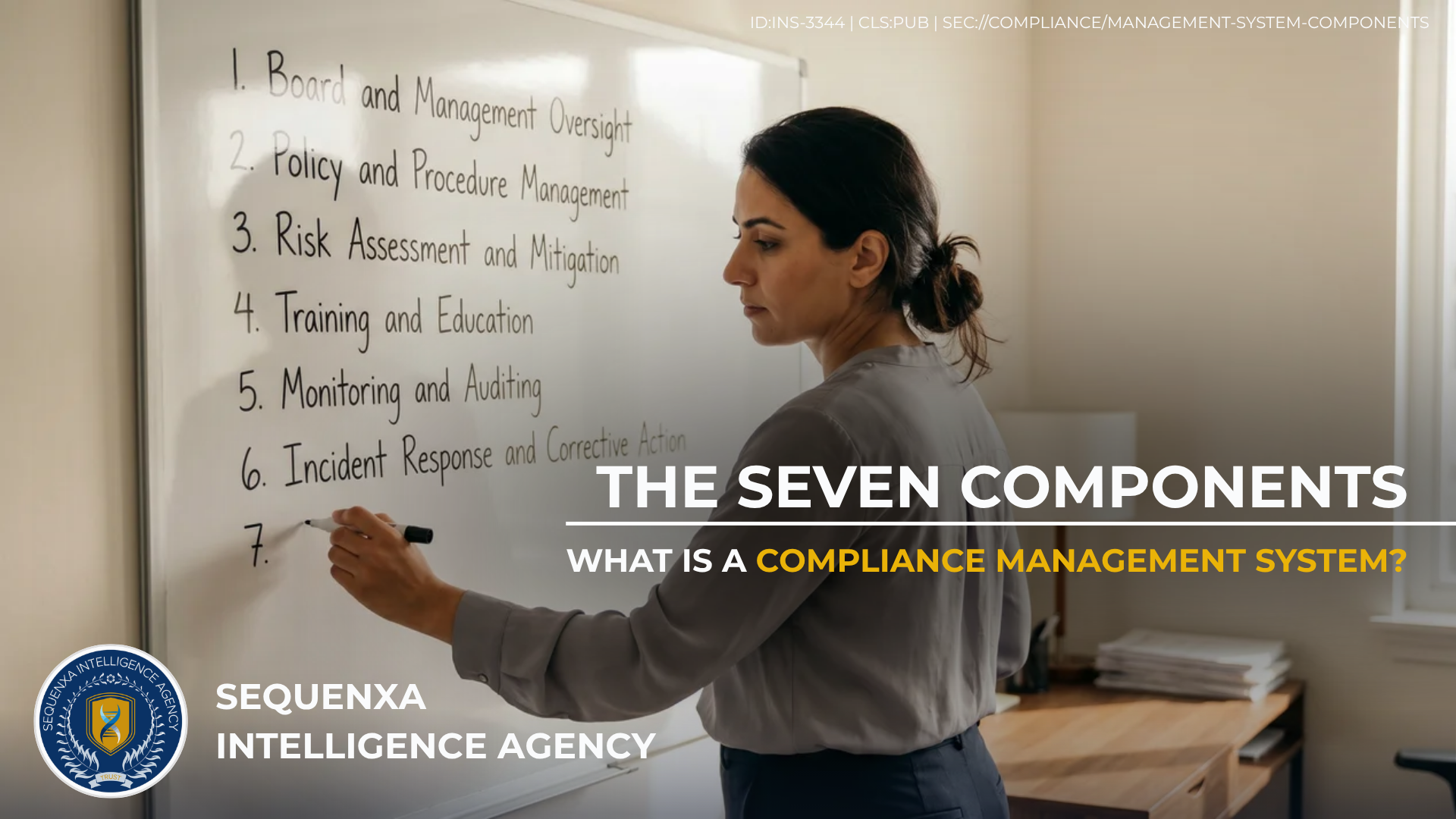
A compliance management system is not one thing. It is seven interdependent functions that must work together to produce continuous, defensible compliance:

1. Board and management oversight.
The board of directors holds ultimate accountability for compliance program integrity. Senior management is responsible for translating board-level compliance objectives into operational controls that function at the department and process level. (ZenGRC, 2024)
2. Policy and procedure management.
Written policies define what compliance requires. Procedures define how employees fulfill those requirements in daily operations. (PECB, 2025) Both must be reviewed and updated when regulations change, new products are introduced, or operational processes shift. (Thomson Reuters, 2025)
3. Risk assessment and mitigation.
A functioning CMS requires periodic risk assessments that identify applicable regulations, score current practices against those requirements, and prioritize controls by risk severity. (PECB, 2025)
4. Training and education.
A documented policy that employees have not been trained on is not a compliance control, it is a record of intent with no operational effect. (FDIC, n.d.) Role-specific training, updated when regulations change or new obligations are introduced, is the mechanism that converts policy into behavior. (University of Pittsburgh School of Law, 2026)
5. Monitoring and auditing.
Continuous monitoring detects compliance violations in real time, before they accumulate into enforcement-level exposure. Periodic internal audits test whether controls are functioning as designed, and external assessments surface issues that internal review may miss. (Approveit, 2026)
6. Incident response and corrective action.
Incident response procedures define how violations are investigated, documented, corrected, and, where required, reported to regulators. A monitoring function that flags violations without a defined escalation and remediation workflow produces data that accumulates without resolution. (ZenGRC, 2024)
7. Compliance reporting.
Regular reporting to senior management and the board maintains organizational visibility into compliance status. Reporting should cover open findings, remediation progress, regulatory changes, and the overall health of the compliance program, not just a pass/fail summary of the last audit cycle.
Compliance Management vs. Compliance Documentation
The distinction regulators draw in enforcement proceedings is between an organization that can show documented controls and an organization that can show those controls were functioning continuously. These are not the same standard, and organizations that conflate them carry significantly more regulatory exposure than they typically recognize.
Documented compliance means policies are written, training records exist, and audit reports have been filed. Operational compliance means those policies are followed, that training is reflected in employee behavior, and that audit findings are remediated rather than filed and deferred. (Thomson Reuters, 2025)
The gap between the two is where most compliance failures originate. An organization can pass an annual audit and experience a compliance-related breach in the following quarter, not because the program failed at audit time, but because monitoring between audit cycles was insufficient to detect the drift that occurred in the intervening months.
Where Programs Break Down
Five structural failure patterns appear consistently in compliance programs that look complete on paper but fail under examination:

Scope gaps. New regulatory requirements are introduced without updating the CMS to cover them. The program faithfully monitors historical obligations while remaining blind to current ones. (Thomson Reuters, 2025)
Ownership gaps. Compliance responsibilities are distributed across functions without clear accountability. Violations occur in the space between departments, each of which assumed another team owned the relevant control.
Monitoring gaps. Policies exist and controls are in place, but monitoring is periodic rather than continuous. Non-compliance accumulates between review cycles without detection, and the next audit discovers findings that have been active for months.
Third-party gaps. The organization's internal compliance program does not extend to vendors, partners, and supply chain relationships. (SailPoint, 2024) A vendor who processes regulated data on the organization's behalf but operates outside its CMS creates regulatory exposure that internal monitoring cannot detect. (Approveit, 2026)
Evidence gaps. Controls exist and are functioning, but the documentation trail that would demonstrate that to a regulator is incomplete, inconsistent, or unverifiable. (ZenGRC, 2024) When an enforcement action or litigation requires proof of control integrity, the organization cannot produce it.
Building a Defensible CMS
A defensible compliance management system is built in sequence. Each step creates the foundation for the one that follows: 1. Assess all applicable requirements. Identify every regulatory framework, law, and industry standard that applies to the organization's operations, products, and jurisdictions. (Sprinto, 2026)
2. Define policies and procedures. Write policies mapped to each applicable requirement and develop procedures that translate policy obligations into specific operational actions.
3. Assign accountability. Designate a compliance officer or compliance committee and define ownership at the department level for each material compliance obligation.
4. Implement training. Deliver role-specific training with documented completion records and update training when regulations change or new obligations are introduced.
5. Establish continuous monitoring. Deploy monitoring systems that detect policy violations, configuration drift, and access anomalies in real time, not just at audit intervals.
6. Build corrective action workflows. Define escalation paths, investigation procedures, remediation timelines, and regulatory notification protocols, ensuring every finding has an owner and a resolution deadline. (PECB, 2025)
Where the Program Cannot See
An internal compliance management system monitors what it was designed to monitor. It does not assess the compliance integrity of third parties, vendors, or partners operating outside its direct control. It does not verify whether the controls it monitors are resistant to exploitation. And it does not surface the behavioral, relational, or structural risks that sit outside the scope of policy-based monitoring.
Third-party compliance gaps require external intelligence to verify, internal programs cannot assess the control integrity of entities they do not govern. For organizations with material vendor relationships, partner dependencies, or supply chain exposure, due diligence investigations provide verified evidence of third-party compliance posture that internal monitoring cannot produce. Where investigations require deeper operational review, executive screening, partner risk assessment, or internal control verification, corporate intelligence services extend that capability beyond what a compliance program is structured to deliver on its own.
Frequently Asked Questions
What is a compliance management system?
A compliance management system is an integrated framework of policies, controls, monitoring processes, and accountability structures that keeps an organization aligned with its regulatory requirements on a continuous basis. It includes board oversight, a compliance program, and a compliance audit function.
What is the difference between compliance management and regulatory compliance?
Regulatory compliance is the state of meeting applicable legal and regulatory requirements. Compliance management is the ongoing process and organizational infrastructure that achieves and maintains that state. One is an outcome; the other is the system that produces it.
What are the core components of a compliance management system?
Board and management oversight, policy and procedure management, risk assessment and mitigation, employee training, continuous monitoring and auditing, incident response and corrective action, and compliance reporting.
Why do compliance programs fail?
The most common failure patterns are scope gaps, ownership gaps, monitoring gaps, third-party gaps, and evidence gaps. Programs that document controls without monitoring them continuously, or that stop at the organization's boundary without extending to third-party relationships, are structurally incomplete regardless of how thorough their documentation is.
What is the difference between a compliance audit and continuous compliance monitoring?
A compliance audit is a periodic review of whether controls were functioning at the time of the audit. Continuous compliance monitoring detects violations in real time, producing an ongoing record of control status rather than a point-in-time snapshot. Both are required components of a defensible compliance management system.
References
ApprovEit. (2026). Understanding Compliance Management: Key Concepts and Best Practices. Retrieved from https://www.approveit.today
FDIC. (n.d.). What Is a Compliance Management System? Retrieved from https://www.fdic.gov
IBM. (2023). What Is a Compliance Management System? Retrieved from https://www.ibm.com
PECB. (2025). What Is a Compliance Management System? Retrieved from https://www.pecb.com
Pipedrive. (2025). 5 Key Compliance Management Steps. Retrieved from https://www.pipedrive.com
Protechtgroup. (2025). Compliance Management Systems: Complete Guide for Business Leaders. Retrieved from https://www.protechtgroup.com
SailPoint. (2024). Best Practices for Compliance Management. Retrieved from https://www.sailpoint.com
ServiceNow. (n.d.). What Is Compliance Management? Retrieved from https://www.servicenow.com
Sprinto. (2026). Compliance Management: Implementation Process. Retrieved from https://www.sprinto.com
Thomson Reuters. (2025). Regulatory Compliance: An Overview. Retrieved from https://legal.thomsonreuters.com
University of Pittsburgh School of Law. (2026). Steps to Build an Effective Compliance Management System. Retrieved from https://online.law.pitt.edu
ZenGRC. (2024). What Is a Compliance Management System? Retrieved from https://www.zengrc.com