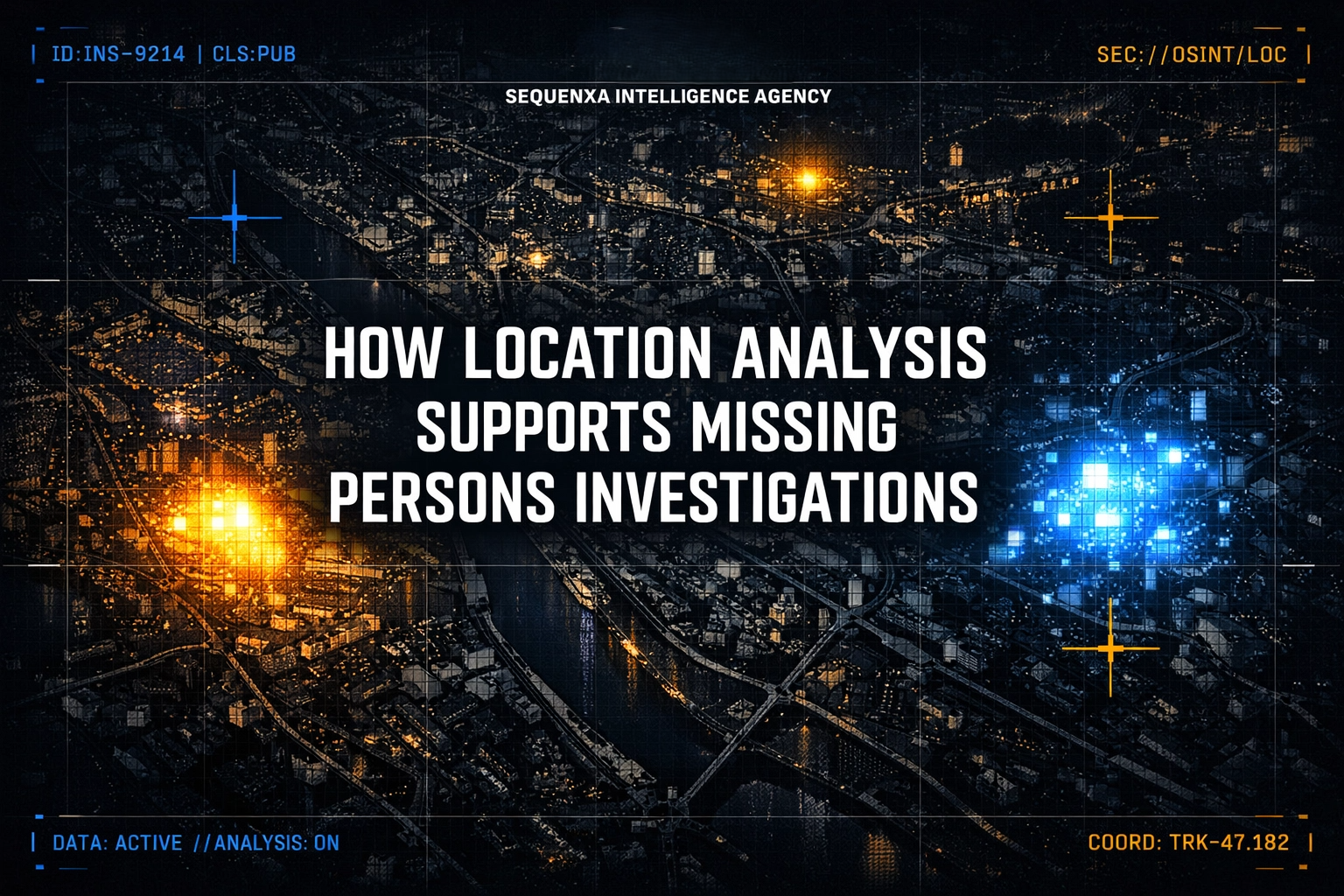
How location analysis supports missing persons investigations
In 2024, the FBI's NCIC processed 533,936 missing person reports. By December 31, more than 93,000 of those records were still active. That's 93,000 people whose last known movements were logged somewhere in a patchwork of cell tower records, GPS coordinates, Wi-Fi connection logs, and transaction receipts that nobody had stitched together yet.
The gap between having location data and actually using it to find someone is where most investigations stall. Police departments collect device records. Families hand over phone bills. Attorneys subpoena carrier data. But the raw information sits in spreadsheets and PDFs, disconnected from the operational question that matters: where did this person go, and what does the pattern tell us about where they are now?
That's what location analysis actually does. It takes fragmented digital and physical traces and reconstructs a coherent picture of movement, timing, and behavior. And in missing persons work, where the first 48 hours are the most consequential and resources are always stretched thin, it's the
difference between searching a city and searching a neighborhood.
What is location analysis in a missing persons investigation?
 Location analysis is the process of collecting, correlating, and interpreting geographic data from digital and physical sources to reconstruct a person's movements and identify where they may be. In missing persons investigations, it combines cell phone location data, GPS records, financial transaction logs, and other digital traces to narrow search areas and generate investigative leads.
It isn't a single tool or technique. It's an analytical framework that pulls from digital forensics, open-source intelligence, and geospatial analysis to answer a specific set of questions: Where was this person? When were they there? What does the sequence of locations tell us about intent, routine, or deviation from routine?
The distinction matters because most investigations treat location data as a supplement to witness interviews or physical searches. In practice, it should be driving those decisions, not following them.
The data that builds the picture
 Every person generates location signals throughout their day, most of them without thinking about it. A single smartphone can produce thousands of location data points in a 24-hour period through cell tower connections, GPS pings, Wi-Fi handshakes, and app-level geolocation requests. Most people have no idea how much they're broadcasting.
In a missing persons case, the most operationally useful data sources tend to fall into a few categories.
Cell tower records show which towers a device connected to and when. They won't give you a street address, but they will give you a sector and a radius. In rural areas, that radius might be several miles. In dense urban environments, it can narrow to a few hundred meters. Call detail records, or CDRs, are typically the first thing investigators request from carriers because they provide a rough timeline of movement based on which towers handled the device's traffic.
GPS data is more precise. Navigation apps, fitness trackers, ride-share services, and even camera metadata embed latitude and longitude coordinates with timestamps. When a missing person's phone had Google Maps running or a fitness app logging a route, that data can reconstruct exact paths.
Wi-Fi connection logs fill gaps that cell tower and GPS data miss. When a phone connects to a coffee shop's network or a hotel's Wi-Fi, it creates a record. These connections can place a person inside a specific building at a specific time, which cell tower data alone cannot do.
Financial transaction records add another layer. Credit card swipes, ATM withdrawals, and digital payment logs carry timestamps and merchant locations. A gas station purchase 200 miles from home tells investigators something cell data alone might not.
Social media and app data add the human layer. Geotagged posts, check-ins, shared locations, and message metadata can reveal not just where someone was, but who they were communicating with and what they were planning.
The value isn't in any single source. It's in the correlation. When cell tower data places someone in a general area, a Wi-Fi log narrows it to a building, and a transaction record confirms they were there buying something at that time, the picture sharpens from a probability to a near-certainty.
How location analysis actually changes an investigation
Here's the part that most explanations skip over. Having the data isn't the hard part. Interpreting it in a way that generates actionable leads is.
Raw cell tower records are not GPS coordinates. A single tower ping might cover a geographic area the size of a small town. Without understanding how cell networks hand off traffic between towers, how signal strength varies with terrain and building density, and how a device selects towers based on load balancing rather than pure proximity, an investigator can draw conclusions that are technically plausible but operationally wrong.
A 2020 study published in Forensic Science International noted that location-related mobile device evidence is prone to misinterpretation by both forensic practitioners and legal decision-makers. The researchers found that without structured evaluation methods, the same cell tower data could support contradictory conclusions about where a person actually was. The problem isn't the data. It's the analysis.
This is where trace analysis becomes the operational engine. Trace analysis looks at the sequence, timing, and density of location signals to reconstruct not just where someone was, but how they were moving. A cluster of signals around a single location over several hours suggests a stop. A rapid sequence of tower handoffs along a highway suggests transit. A sudden gap in all signals suggests the device was turned off, entered a dead zone, or was deliberately disabled.
In missing persons investigations, these patterns answer questions that witness statements and physical searches can't. Was the person following their normal routine before they disappeared? Did they deviate from it? If so, when and where did the deviation start? Did they move voluntarily toward a destination, or does the pattern suggest they were taken somewhere?
Timeline reconstruction: the first 48 hours and beyond
 The first two days after a person goes missing are the most productive for recovery. After that, the probability of a safe return drops. Location analysis has the most impact when it's applied early, before trails go cold and data retention windows close.
Timeline reconstruction works by layering every available location signal onto a single chronological map. The goal is to account for as much of the person's time as possible in the hours and days before they went missing, then extend that timeline forward to identify the last confirmed signal.
In practice, this means pulling CDRs, transaction records, and app data simultaneously and aligning them by timestamp. The result is a minute-by-minute accounting of where the person's devices were, which routes they traveled, and what stops they made.
The last confirmed signal is the most critical data point. It defines the starting area for physical searches and intelligence collection. But the signals leading up to it matter too. If the timeline shows a person visiting an unfamiliar address repeatedly in the week before they disappeared, that address becomes a lead. If financial records show cash withdrawals in a pattern that suggests planning, the investigation shifts from accidental disappearance to voluntary departure or coercion.
The timeline also identifies gaps. Periods where no location data exists raise their own questions. A phone that was active every day for months and then goes silent at 3:00 AM on a Tuesday is telling you something.
Why digital forensics and location analysis work together
 Location data tells you where. Digital forensics tells you why.
A phone's location history might show someone drove to an unfamiliar area three times in the week before they vanished. Digital forensics on the same device might reveal they were searching for directions to that area, exchanging messages with someone at that location, or researching topics that explain the visits.
Mobile device forensics has become a core investigative capability for this exact reason. Smartphones contain messaging history, search queries, calendar entries, notes, saved locations, and app-specific data that contextualizes movement. A device that pinged a cell tower near a train station might also contain a purchased ticket, a boarding notification, or a message saying "I'll be there at noon."
The combination of location analysis and device forensics also helps investigators distinguish between different scenarios. A person whose phone shows a clean break, no signals after a specific time, no prior indicators of planning, no unusual communication, fits a different profile than someone whose digital traces show weeks of preparation.
In cross-border cases or situations where someone may have been moved between jurisdictions, this combined approach becomes even more important. Financial records might show a passport-related transaction. Device data might reveal a travel booking app was opened. Location data confirms the person's phone was last active near an international airport.
Geolocation analysis and narrowing search areas
When a search team has unlimited resources and a small area to cover, they don't need much help. That's never the situation.
Geolocation analysis converts raw location data into prioritized search areas. Instead of covering every possible location where a missing person might be, investigators can focus on the zones where the data says they most likely are or were.
This works by combining multiple data sources to identify convergence points. If cell tower data suggests a person was somewhere in a 5-mile radius, and a Wi-Fi connection log places them at a specific cafe within that radius, and a transaction record shows they made a purchase nearby, the effective search area shrinks from dozens of square miles to a few city blocks.
In rural or wilderness cases, geolocation analysis helps differently. GPS data from a fitness tracker or navigation app might show the last recorded route. Terrain modeling can identify areas along that route where a person might have left the path. Weather data for the time period narrows which conditions they would have faced.
The operational outcome is straightforward: less time spent searching places the person never was.
When location analysis should be used in a missing persons case
The short answer is immediately.
Every hour that passes between a disappearance and the start of location analysis means data that becomes harder to obtain. Cell carriers retain CDRs for varying periods, some as short as a few months. Cloud-based app data can be overwritten. Wi-Fi logs at businesses may be purged weekly. Financial institutions maintain transaction records longer, but the window for real-time account monitoring narrows quickly.
More specifically, location analysis should be initiated whenever a missing persons case involves any of the following conditions: the person had a mobile device, they used digital financial services, they had social media accounts, or they were known to frequent specific locations with surveillance infrastructure.
That covers nearly every adult and most teenagers in the developed world.
The cases where location analysis provides the highest return include situations where the person disappeared without warning and has no history of voluntary disappearance, cases involving potential foul play where reconstructing the person's last movements could identify suspects, cross-jurisdictional disappearances where the person may have traveled or been moved, and cases where traditional investigative methods have reached a dead end.
For families and legal teams who have exhausted conventional channels, private intelligence-led location analysis can access and interpret data sources that public agencies may lack the resources or expertise to process.
The uncomfortable truth about resource constraints
Law enforcement agencies in the United States handle hundreds of thousands of missing person reports every year. Most departments don't have dedicated digital forensics units. Many don't have a single analyst trained in geolocation analysis or cell tower interpretation.
The Springer Nature study on multimodal data integration in missing persons cases found that combining digital forensics with location data improves investigative outcomes, but noted that the capability requires specialized tools and training that many agencies lack. The researchers proposed a framework for integrating location history, mobile phone data, social media analysis, and eyewitness information into a unified analytical process. That framework exists as a research paper. Most field investigators have never heard of it.
This isn't a criticism of law enforcement. It's a description of reality. When a department processes thousands of cases per year with a handful of detectives, the complex digital analysis that could narrow a search area from a county to a city block doesn't happen. Not because anyone decided it wasn't important, but because there's nobody available to do it.
Private intelligence-led investigation fills that gap, not by replacing law enforcement but by providing analytical capabilities that most agencies can't maintain in-house. The work product feeds back into the official investigation as actionable intelligence: here's where the data says the person was, here's the pattern we identified, here's where the search should focus next.
What location analysis can't do
It's worth being direct about the limitations.
Location analysis reconstructs where a device was, not necessarily where a person was. A phone left in a car while someone walks into the woods won't show the walk. A device that was handed to someone else will track the wrong person. A phone that was turned off or placed in a Faraday bag will produce no data at all.
The precision of the data varies enormously. GPS coordinates can be accurate to within a few meters. Cell tower records might place a phone within a sector that spans several square miles. Wi-Fi logs depend on the range of the access point. Treating all location data as equally precise leads to bad decisions.
And there are legal constraints. Accessing carrier records typically requires legal process. Social media data may be protected by platform terms of service or privacy laws depending on the jurisdiction. Even data that's technically available may be inadmissible if it wasn't obtained through proper channels.
That doesn't make the work less valuable. It means the analysis has to be conducted by people who understand both the technical capabilities and the legal boundaries, and who can tell the difference between what the data shows and what they want it to show.
Frequently asked questions
What is location analysis in an investigation?
Location analysis is the process of collecting, correlating, and interpreting geographic data from digital and physical sources to map a person's movements. In investigations, it draws on cell phone location data, GPS records, financial transactions, Wi-Fi logs, and social media activity to reconstruct timelines and identify where a person was at specific times.
How does location analysis support missing persons investigations?
It narrows search areas by identifying where a missing person's devices were last active, reconstructs their movements in the hours and days before they disappeared, identifies patterns or deviations from routine behavior, and generates leads that direct field investigators and search teams to the most productive locations.
What role does digital forensics play in missing persons cases?
Digital forensics extracts and analyzes data from electronic devices including messaging history, search queries, app data, and location logs. In missing persons cases, this evidence provides context for location data, such as communication with specific individuals, travel planning, or behavioral changes that help investigators understand not just where the person went, but why.
How can cell phone location data help investigators?
Cell phone location data, including cell tower records, GPS coordinates, and Wi-Fi connections, creates a trail of a person's movements over time. Investigators use this data to identify the last known location, reconstruct travel routes, and narrow search parameters. When correlated with other evidence, it can reveal patterns of behavior that are invisible through witness interviews alone.
What types of data are used in location analysis?
Location analysis draws on cell tower records (CDRs), GPS data from devices and apps, Wi-Fi connection logs, financial transaction records with merchant locations, social media geotags and check-ins, surveillance camera footage with timestamps, and IoT device data from wearables and connected vehicles.
How does geolocation analysis narrow search areas?
Geolocation analysis combines multiple data sources to identify convergence points where different types of evidence place a person in the same area. By overlaying cell tower coverage, Wi-Fi connections, transaction locations, and other signals, analysts reduce broad geographic possibilities to specific zones that warrant concentrated search effort.
Sources
FBI Criminal Justice Information Services. (2025). 2024 NCIC Missing Person and Unidentified Person Statistics. Federal Bureau of Investigation. https://www.fbi.gov/file-repository/cjis/2024-ncic-missing-and-unidentified-person-statistics.pdf
Office of Juvenile Justice and Delinquency Prevention. (2025). Missing and Exploited Children. U.S. Department of Justice. https://ojjdp.ojp.gov/programs/missing-and-exploited-children
Alemayehu, M., Araujo, I.I., & Chrysikos, A. (2025). Enhancing Digital Forensic Analysis for Locating Missing Persons: Multimodal Data Integration. Springer Nature. https://link.springer.com/chapter/10.1007/978-981-96-0143-1_10
de Gruijter, M., et al. (2020). Structuring the Evaluation of Location-Related Mobile Device Evidence. Forensic Science International: Digital Investigation. https://www.sciencedirect.com/science/article/pii/S2666281720300238
International Association of Computer Investigative Specialists. (2025). Mobile & Digital Forensics: How Do Experts Extract Data from Phones? ForensicsColleges.com. https://www.forensicscolleges.com/blog/guide-to-mobile-forensics
Sequenxa conducts missing persons investigations using location analysis, digital forensics, and open-source intelligence. If traditional channels have been exhausted and you need investigative-grade location analysis applied to an active case, request a confidential consultation.
Ready to Take the Next Step?
Learn how Sequenxa can help protect your organization with intelligence-driven solutions.
Get Started