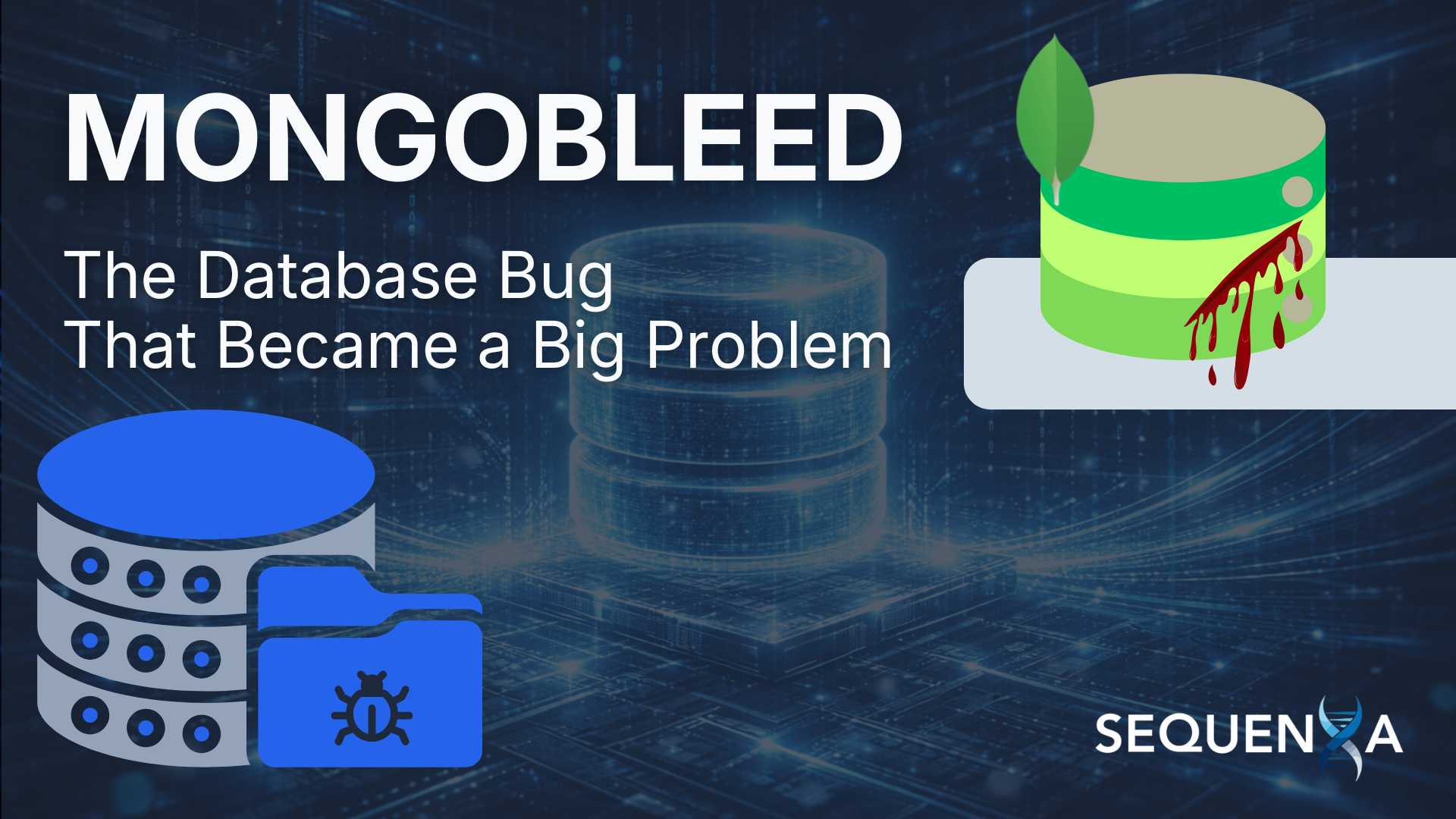
MongoBleed: The Database Bug That Became a Big Problem
What Is the MongoBleed Vulnerability? (CVE-2025-14847)
The disclosure of CVE-2025-14847, widely referred to as the MongoBleed vulnerability, represents a critical moment for database security. Similar in mechanics and severity to the infamous Heartbleed bug of 2014, this vulnerability allows attackers to read sensitive memory from MongoDB servers without needing a password or username.
For enterprise security teams, the implications are immediate: a remote exploit that can expose authentication tokens, personally identifiable information (PII), and session keys without leaving traditional audit trails. This guide breaks down exactly how the flaw works and what you must do to secure your infrastructure.
“Memory disclosure attacks rarely make noise, and that’s what makes them deadly. If you treat MongoBleed like a routine patching event, you’ve already underestimated the blast radius.”
How the Vulnerability Works
At its core, MongoBleed is a heap memory disclosure flaw. It happens inside the MongoDB wire protocol, specifically in the code that handles zlib compression (message_compressor_zlib.cpp).
The Problem With Data Size
The exploit takes advantage of a mistake in how MongoDB handles compressed data. When a message is sent to the server, it includes a header that tells MongoDB how big the data will be once it is uncompressed.
In a normal situation, the server creates a memory space (buffer) that matches this size. However, the vulnerability exists because the server does not double-check that the actual data fills this entire space. An attacker can send a malicious packet that says "I am sending 1MB of data," but only provide 1KB of actual content.
Because MongoDB creates this space using memory that hasn't been wiped clean, the server allocates the 1MB buffer, writes the tiny 1KB of data, and leaves the rest filled with "ghost memory", data left over from previous database operations. The server then processes this and sends it back to the attacker during an error response.
Why You Don't Need a Password
The most dangerous part of MongoDB CVE-2025-14847 is when it happens. The compression step takes place before authentication. This means an attacker does not need valid credentials to trigger the leak, they only need network access to the MongoDB port (default 27017). This makes any internet-exposed instance an easy target for automated attacks.
Example: A university’s unprotected research database was targeted within six minutes of being indexed by an internet-scanning bot, no credentials required, only open port 27017.
Do you think databases should ever be directly exposed to the public internet?
What Data Can Be Stolen?
Unlike vulnerabilities that let attackers take control of a server (RCE), a MongoDB memory leak steals secrets. However, in a high-security environment, the result is often the same. The memory exposed by MongoBleed is the active workspace of the database.
High-value items likely to be in this memory include:
Passwords and Keys: Credentials from recent login attempts.
Session Tokens: Active IDs that allow attackers to bypass login screens entirely.
Customer Data: Fragments of BSON documents, including PII, financial records, or healthcare data.
System Info: Internal IP addresses and server configurations.
For companies that must follow GDPR compliance or PCI rules, a confirmed MongoBleed exposure should be treated as a full data breach.
“Data fragments don’t look dangerous until you realize how attackers stitch them together. MongoBleed is a puzzle piece delivery system.”
Which Versions Are Affected?
The vulnerability affects nearly eight years of MongoDB releases. If you are running a version with zlib compression enabled (which is common), you are likely at risk.
List of Versions to Fix

Note on MongoDB Atlas: MongoDB has stated that their managed Atlas clusters were patched before the public news came out. However, if you are debating self-hosted MongoDB vs Atlas, you must manually check your own servers, especially those in Docker or Kubernetes.
Do you track your database patch cadence as closely as your application dependencies?
“Managed services reduce risk but don’t eliminate responsibility. Self-hosting means self-checking, every time.”
Monitor for Unusual Behavior
Because this attack does not require a login, standard "failed login" alerts will not save you. You must monitor for unusual behavior in your network traffic and logs to catch an ongoing MongoBleed exploit.
Watch for Network Spikes
Sudden Connection Bursts: The exploit is not efficient; attackers often need to send thousands of requests to get useful data. Look for a massive spike in connections, often exceeding 500 per minute, originating from a single IP address.
Broken Data Streams: The exploit relies on malformed data packets. This often causes the connection to break unexpectedly. A high volume of reset connections (TCP resets) is a strong warning sign.
Logs for Missing Data
Legitimate database drivers (like those for Python, Java, or Node.js) always introduce themselves when they connect. Attack tools typically skip this politeness.
Missing Metadata (ID 51800): If you see many connections that skip the "hello" handshake where client metadata is shared, investigate immediately.
Rapid Connect/Disconnect: Watch for a pattern where a specific IP connects (ID 22943) and disconnects (ID 22944) repeatedly in a fraction of a second. This "stuttering" behavior is a hallmark of the scanner used in the MongoBleed proof of concept.
Should malformed traffic trigger automated IP blocking, or does that risk false positives?
How to Fix and Protect Your System
You need to fix the software immediately and then clean up any potential mess left behind.
1. The Best Fix: Update Your Software
The only permanent solution is to install the official patch.
Action: Update your database to MongoDB patch versions 8.2.3, 8.0.17, 7.0.28, or the correct one for your version.
Process: Follow your standard upgrade steps. For Kubernetes MongoDB security hardening, update your container images right away.
2. Quick Fix: Turn Off zlib Compression
If you cannot update immediately, you can stop the attack by turning off the zlib feature.
Action: Change your configuration file (mongod.conf) to remove zlib from the networkMessageCompressors list.
Command: mongod –networkMessageCompressors snappy,zstd
Note: This might slow down your network slightly, but it completely stops the MongoDB zlib vulnerability.
3. Change Your Passwords
Because this bug leaks memory, you must assume that any password or key in memory could have been stolen.
Requirement: Rotate MongoDB credentials after patch. This means changing database user passwords, cluster keys, and any API keys used by your apps.
Scope: Treat this seriously. If your database was on the internet, assume the secrets are gone.
4. Proper Authentication & Access Controls
While patching stops the leak, proper authentication & access controls prevent the attacker from reaching your door in the first place.
Network Access Control: The fact that 87,000 MongoDB instances are vulnerable highlights a failure in basic blocking. Use a firewall or VPN to ensure your database port (27017) is never exposed to the public internet. If they can't connect, they can't bleed the memory.
Principle of Least Privilege: Even if an attacker steals a credential via a memory leak, proper access controls limit the damage. Ensure every database user has only the exact permissions they need. A leaked "read-only" credential is bad, but a leaked "root" credential is catastrophic.
What should come first: patching the leak or rotating secrets?
Patch first, rotate second, restrict access third, complete this triage order within 72 hours.
FAQs
Is MongoDB Atlas affected by MongoBleed?
No. MongoDB has stated that MongoDB Atlas is not affected by MongoBleed because they applied the patches to their cloud infrastructure before the vulnerability was publicly disclosed. However, this safety does not apply to self-hosted instances running on AWS EC2, Azure, or Google Cloud.
Can I just use a firewall instead of patching?
A firewall is a strong mitigation but not a permanent fix. If you restrict port 27017 to only trusted internal IPs, an external attacker cannot exploit the vulnerability. However, an insider threat or a compromised internal server could still launch the attack. Patching is the only complete solution.
How is MongoBleed different from Heartbleed?
While MongoBleed vs Heartbleed is a common comparison due to the "memory leak" nature of both, they affect different systems. Heartbleed affected the OpenSSL library used by web servers, while MongoBleed affects the MongoDB database server directly. Both, however, are catastrophic because they allow the theft of secrets without authentication.
Does this vulnerability allow Remote Code Execution (RCE)?
Technically, no. CVE-2025-14847 is a read-only memory disclosure. However, if an attacker uses the leak to steal an administrator's session token or password, they can log in and perform actions that are effectively as damaging as RCE, such as deleting data or installing ransomware.
Protect what should stay private
The MongoBleed vulnerability is a reminder that even internal database tools can have serious safety flaws. While the MongoDB security advisory December 2025 gives us the patches we need, it is up to security leaders to apply them quickly. By treating this issue with urgency, patching now, rotating secrets, and enforcing strict access controls, you can protect your data from theft.
Protect Data Integrity
The MongoBleed vulnerability serves as a reminder that even internal protocols like compression can harbor severe risks. While the MongoDB security advisory December 2025 provides the necessary patches, the responsibility lies with security leaders to enforce them. By patching immediately, rotating credentials, and maintaining strict access controls, organizations can effectively neutralize this threat and protect their data integrity.
Want support? We work with select organizations in these sectors. You can request an introduction on our website.
References
Tenable, Inc. (2025). CVE-2025-14847 (MongoBleed): MongoDB memory leak vulnerability exploited in the wild. Retrieved from https://jp.tenable.com/blog/cve-2025-14847-mongobleed-mongodb-memory-leak-vulnerability-exploited-in-the-wild Tenable®
Varonis Systems Inc. (2025). MongoBleed (CVE-2025-14847): Risk, detection & how Varonis protects you. Retrieved from https://www.varonis.com/blog/mongobleed-cve-2025-14847-memory-leak-vulnerability Varonis
National Institute of Standards and Technology. (2025). CVE-2025-14847 detail. Retrieved from https://nvd.nist.gov/vuln/detail/CVE-2025-14847 NVD
MongoDB, Inc. (2025). Important MongoDB patch available – server releases. Retrieved from https://www.mongodb.com/community/forums/t/important-mongodb-patch-available/332977 MongoDB
Orca Security. (2025). CVE-2025-14847: MongoDB memory leak alert. Retrieved from https://orca.security/resources/blog/cve-2025-14847-mongodb-heap-memory-leak/ Orca Security
Red Hot Cyber Ltd. (2025). CVE-2025-14847: Critical MongoDB vulnerability exposed. Retrieved from https://www.redhotcyber.com/en/post/critical-mongodb-vulnerability-exposed-cve-2025-14847/ Red Hot Cyber