Somalia’s UN Envoy: Linked to Sanctioned Medicaid Agency
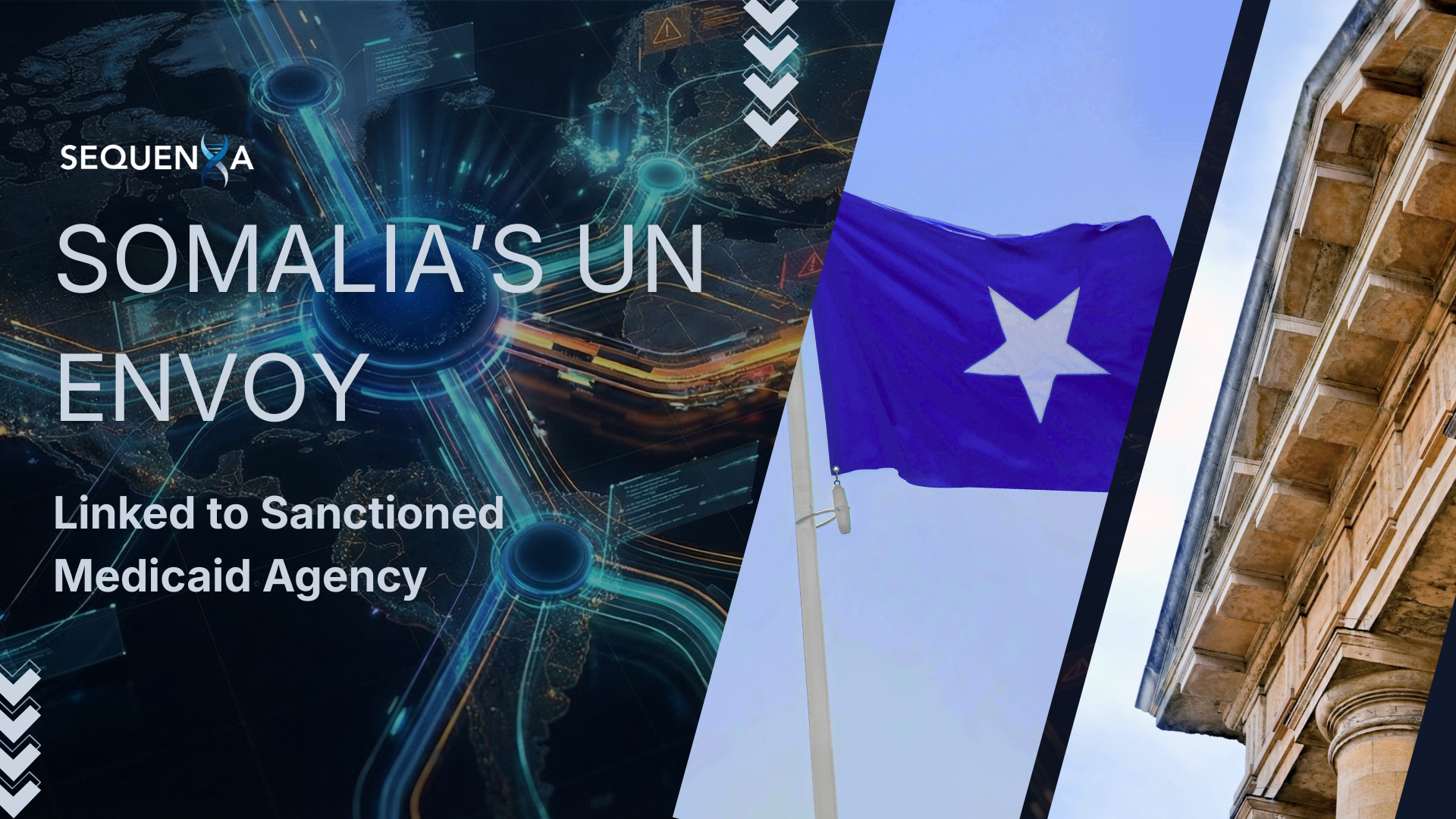
Somalia's Permanent Representative to the United Nations, Abukar Dahir Osman, now serves as president of the UN Security Council, a position his nation has held only once in the past 54 years. Yet on January 5, 2026, the U.S. Department of Health and Human Services issued a statement that shook his diplomatic standing: Deputy HHS Secretary Jim O'Neill publicly confirmed that Osman is in fact associated with Progressive Health Care Services, a home health agency in Cincinnati that had previously been convicted of Medicaid fraud.
The revelation did not emerge from routine government audits. Instead, it surfaced through social media speculation that caught the attention of federal officials, and then the world.
This scandal is not about a single diplomat or a single health company. It exposes a systemic vulnerability that threatens every organization: the inability to see the hidden networks that connect people, money, and risk. For CEOs and organizational leaders, the Osman case is a masterclass in what happens when relationship mapping fails.
Did you know? According to federal enforcement data, more than 70% of large Medicaid fraud cases involve undisclosed relationships or conflicts of interest rather than simple billing errors.
How many senior leaders in your organization have past regulatory authority in industries where they now hold private interests?
The Pattern of Concealment
Osman's career trajectory reveals how complex networks can hide in plain sight. From 2007 to 2012, he served as a supervisor in the Franklin County, Ohio Department of Job and Family Services, directly overseeing the Adult Medicaid unit. During this same period, he founded Beacon Educational Services and later became associated with Progressive Health Care Services in Cincinnati. His roles spanned three distinct domains: government oversight, private business, and healthcare administration.
On the surface, these positions look like normal career progression. But when mapped together, they form a pattern: a government official with direct authority over Medicaid spending also held private business interests in the same healthcare ecosystem he was supposed to regulate.
This is not a unique situation. Across the broader Minnesota fraud scandal, federal prosecutors alleged that sophisticated criminal schemes involved false and inflated billing, provision of medically unnecessary services, kickback arrangements, and intentional misrepresentation of patient information. What enabled these schemes to reach $9 billion in alleged losses was the inability of agencies to connect the dots between related entities.
Progressive Health Care Services remained an active Ohio corporation even after its Medicaid fraud conviction. Online posts linked it to multiple other healthcare companies at the same address, with overlapping Somali names and overlapping ownership structures. No agency had mapped these relationships until media attention forced the issue.
Example: In Minnesota, multiple home health agencies operating from the same address used distinct corporate names but shared officers and bank accounts, delaying detection for years.
Did you know? Federal prosecutors estimate that networked fraud structures amplify losses by up to 5x compared to single-entity schemes.
Why Traditional Oversight Missed This
The Minnesota fraud cases tell the story. Approximately 98 individuals have been charged in connection with various schemes since 2020, with 62 convictions as of January 2026. The alleged fraud touched 14 different Medicaid programs, behavioral intervention services, housing stabilization, personal care assistance, and more. Yet the scale of the schemes only became visible after federal investigators adopted a different approach: they looked for patterns across programs and entities, not within single organizations.
One key insight: many of the schemes involved individuals operating through multiple entities simultaneously. One perpetrator, Asha Farhan Hassan, pled guilty for roles in both a $14 million autism fraud scheme and the separate Feeding Our Future scandal. She was not caught because any single organization detected fraud. She was caught because investigators started mapping her network.
The Osman case is similar. He transitioned from government supervisor to private healthcare executive to UN ambassador, roles that ordinarily never get analyzed together. His background check for UN appointment would have reviewed his career. His business entities were registered in state records. But no one had constructed a unified view of his relationships, conflicts of interest, and simultaneous roles across these domains.
Example: Asha Farhan Hassan’s involvement in both an autism services fraud and the Feeding Our Future scandal only emerged when investigators linked her activities across unrelated programs.
“Program-by-program oversight is obsolete in an era of multi-entity financial engineering.”
Are your audits designed to detect isolated violations, or coordinated behavior across departments and subsidiaries?
The Cost of Relationship Blindness
For organizations, this blindness is catastrophic. When CEO compensation consultants evaluate executive appointments, they rarely map an individual's current board seats, business interests, and regulatory roles simultaneously. When compliance teams audit vendor relationships, they often do not trace ownership back through shell entities. When government agencies allocate contracts, they typically do not connect the dots between provider networks, ownership stakes, and historical fraud findings.
The Osman scandal forced this visibility. Elon Musk posted on X demanding his arrest. The HHS deputy secretary issued a public statement. The UN faced questions about its vetting process. All of this stemmed from a simple fact: no one had constructed a relationship map.
Yet relationship mapping would have revealed the risk years earlier. A complete map would have shown:

Osman's supervisory role in the Medicaid unit (2007-2012)
His concurrent founding of Beacon Educational Services (1999-2005)
His association with Progressive Health Care Services during overlapping years
Progressive's later Medicaid fraud conviction
His subsequent transition to full-time UN ambassador role (2017-present)
This timeline alone raises questions about conflict of interest, disclosure, and oversight.
“Reputation damage is often irreversible once relationships are exposed retroactively.”
Identify hidden relationships proactively, before social media, regulators, or competitors do it for you.
What CEOs Must Do
For organizational leaders, the message is clear: relationship mapping is not a compliance nice-to-have. It is a governance imperative.

First, map your board members and executives across all current roles. Do not accept a resume that lists only current employment. Demand to know every board seat, advisory role, private business interest, and public service position. Then ask: where are the conflicts?
Second, trace your vendor and partner relationships upstream. Who owns your suppliers? Who owns their suppliers? One layer of ownership may look clean. Three layers back, you may find fraud convictions, sanctions, or disqualifications.
Third, look for the network, not the individual. The Minnesota fraud cases scaled to billions because perpetrators operated through networks of related entities. A single daycare center billing Medicaid looks suspicious. Twenty related centers, with overlapping ownership, using coordinated recruitment strategies, that is industrial-scale fraud, and it only becomes visible through relationship mapping.
Fourth, invest in tools and processes that automate this work. Relationship mapping at the Osman scale requires technology. You cannot do it with spreadsheets. You need systems that can ingest regulatory filings, business registrations, sanctions databases, and news alerts, then automatically construct networks and flag conflicts.
Do your current tools allow you to see conflicts three layers deep, or only what’s disclosed voluntarily?
Invest in technology that continuously maps executive, vendor, and partner relationships in real time.
FAQs
Who is Abukar Dahir Osman and what is the Osman scandal?
Abukar Dahir Osman, Somalia’s UN ambassador and UN Security Council president in 2026, is alleged to be linked to Progressive Health Care Services, a Cincinnati agency previously convicted of Medicaid fraud.
How does this case relate to Minnesota Medicaid fraud investigations?
Federal prosecutors say the Osman scandal reflects the same network-based tactics seen in Minnesota Medicaid fraud, where overlapping entities, false claims, and kickback arrangements led to billions in alleged losses.
What is Progressive Health Care Services and why is it controversial?
Progressive Health Care Services is an Ohio home health company that remained active after a Medicaid fraud conviction and was later linked through reporting to Abukar Osman.
Can diplomats be prosecuted for Medicaid fraud in the United States?
Diplomats generally cannot face federal Medicaid fraud charges unless their home country waives immunity under U.S. diplomatic immunity rules.
How is this similar to the Feeding Our Future scandal?
Like the Feeding Our Future case, the Osman scandal shows how Medicaid fraud schemes expand when agencies fail to map hidden relationships across nonprofits, businesses, and government roles.
The Path Forward
The Somalia UN ambassador scandal will fade from headlines. Diplomatic processes will continue. Investigations may or may not result in charges, diplomatic immunity laws are complex, and the U.S. State Department has not indicated whether it will waive Osman's immunity.
But the structural lesson will persist: organizations that do not map relationships are blind to risk.
Osman's case involved a diplomat, a health agency, and a government Medicaid office. But the same logic applies to your organization. Your vendor may own an entity that owns another entity that poses compliance risk. Your board member may have financial interests you cannot see until you map them. Your executives may have conflicts that only become visible when you stop looking at individuals in isolation.
The cost of this blindness is not abstract. It is measured in fraud losses, regulatory fines, reputational damage, and lost stakeholder trust. The Minnesota cases alone represent billions in losses. The Osman scandal represents a permanent stain on Somali-American diplomatic standing.
The solution is not complex. It is systematic: map the relationships before you allocate resources, appoint leaders, or sign contracts.
To learn how to build relationship mapping into your organization's governance framework, visit our website.