Why a Background Check Is Not the Same as Corporate Intelligence
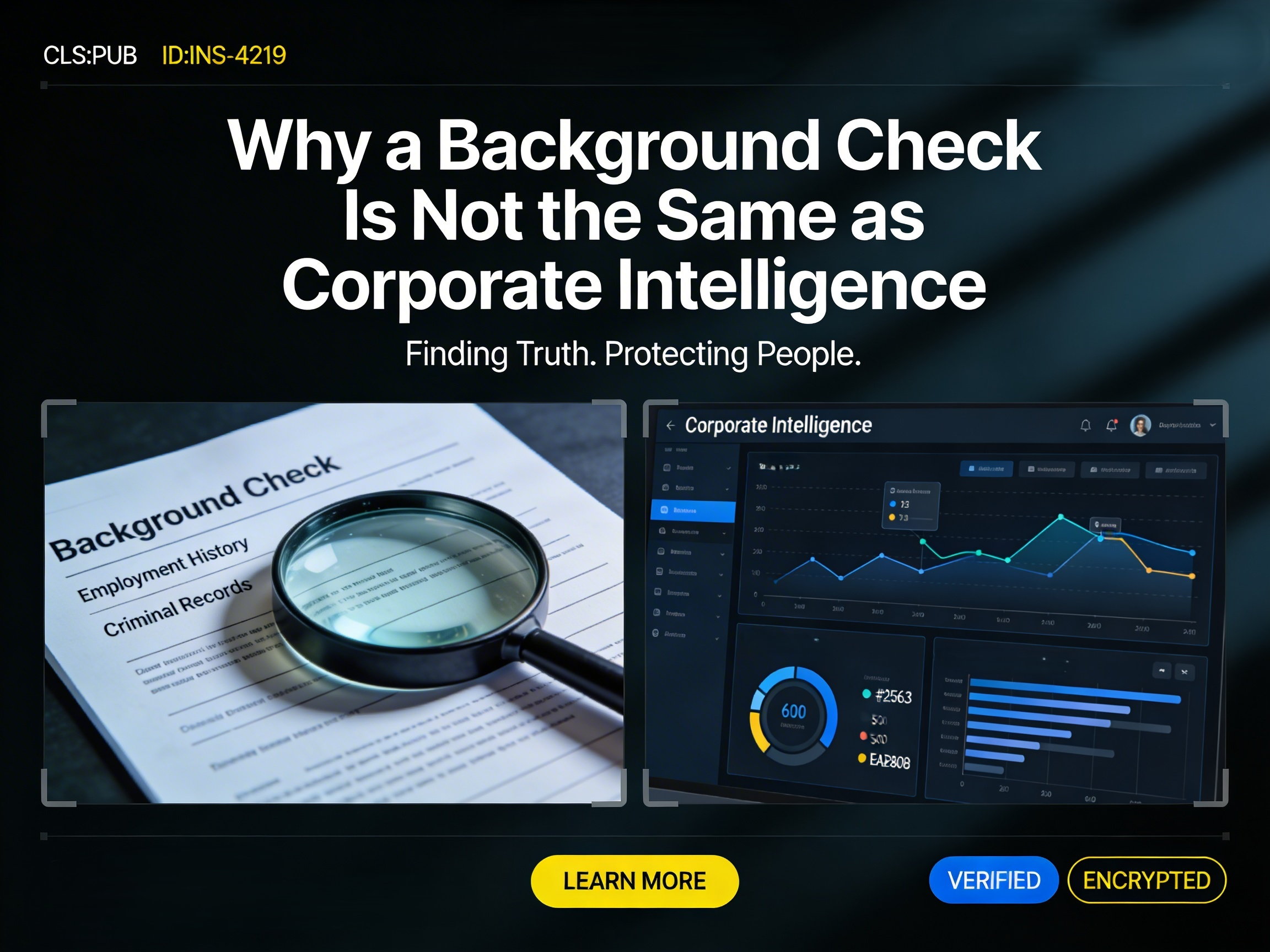
A background check tells you whether someone has a criminal record in the counties you searched. Corporate intelligence tells you whether the person sitting across the table is who they say they are, whether their company is what it claims to be, and whether the deal in front of you is worth the paper it's printed on.
Most organizations treat these as interchangeable. They are not.
The confusion costs real money. According to the FTC, consumers reported losing more than $12.5 billion to fraud in 2024, a 25% increase over the prior year. That number doesn't capture what corporations lose when they enter partnerships, make acquisitions, or hire executives based on information that was technically "checked" but never actually investigated.
This article breaks down what background checks cover, where they stop, and why corporate intelligence services exist to fill a gap that most organizations don't realize is there until the damage is done.
What a background check actually does
A standard background check is a database query. It pulls criminal history from specific jurisdictions, runs a name through sex offender registries, confirms a Social Security number is valid, and may include a credit report. Some checks add employment verification and education confirmation. The entire process runs through automated systems, and in most cases, no human analyst touches the results.
That process works for what it was designed to do: screen large volumes of applicants against a known set of compliance criteria. It answers simple yes-or-no questions. Does this person have a felony conviction in this state? Is the SSN active? Did they attend the school they listed?
Here's what it doesn't answer: Is the school they listed legitimate? Did they actually do the job they described? Are there civil suits pending against them in another jurisdiction? Do they control shell companies with undisclosed conflicts of interest? Are the references they provided real people?
HireRight's employment screening research found that 85% of surveyed employers uncovered lies or misrepresentation on a candidate's resume during screening. A 2023 ResumeLab survey put the number even higher, with 70% of job applicants admitting they had lied or would consider lying on their resume. Standard background checks miss most of it because they were never designed to find it.
Where background checks stop
Background checks aren't useless. They serve a compliance function that matters. But organizations routinely use them as a risk management tool, and they were never built for that job.
The blind spots are structural, not accidental.
Criminal records are jurisdiction-specific. A check that searches three counties misses convictions in the other three thousand. Federal records require separate searches. International records require entirely different processes and often local on-the-ground research.
Employment verification, when it happens at all, typically confirms dates and titles. It does not confirm what someone actually did, how they performed, or why they left. That gap between title confirmation and operational reality is where the most consequential misrepresentations live.
Education verification checks whether a degree was conferred. It does not check whether the institution itself is credible. Diploma mills are still operating. The FTC maintains resources to help employers identify them, but most automated screening platforms don't flag them.
Financial exposure, corporate affiliations, beneficial ownership structures, sanctions exposure, regulatory history, and reputational risk sit entirely outside the scope of any standard background check. None of this is optional information when you're onboarding a C-suite executive, approving a vendor with access to sensitive data, or entering a joint venture with a firm you found through a referral.
What corporate intelligence actually covers

Corporate intelligence services don't replace background checks. They operate in a different category entirely. A background check is a records query. Corporate intelligence is an analytical process run by investigators who know what to look for, where to look, and how to connect information across sources that automated systems can't reach.
Here's what that looks like in practice.
Identity verification beyond documents
Identity verification services at the intelligence level go past document authentication. They cross-reference digital footprints, social media activity patterns, professional history timelines, and corporate affiliation records to confirm that a person's claimed identity holds together across multiple independent sources. Synthetic identity fraud — fabricated identities assembled from stolen and manufactured data — is something no database check was designed to catch. It requires pattern analysis.
Beneficial ownership and corporate structure analysis
A background check doesn't tell you who actually owns the company you're about to do business with. Due diligence investigations trace ownership through layered corporate structures, shell entities, and cross-jurisdiction registrations to identify who sits at the end of the chain. That information determines whether the entity meets sanctions compliance requirements, whether there are undisclosed conflicts of interest, and whether the corporate structure itself was designed to obscure something.
PwC's 2024 Global Economic Crime Survey found that procurement fraud ranked among the top three most disruptive economic crimes globally. Much of that fraud moves through third-party relationships that organizations approved based on surface-level vetting.
Financial forensics and transaction pattern analysis
Background checks don't examine financial behavior. Corporate intelligence does. Forensic accounting follows funds through layered accounts and structures to identify irregularities that standard audits are not built to detect. The ACFE's 2024 Report to the Nations found that the median loss per occupational fraud case reached $145,000, with over a fifth of cases exceeding $1 million. Those losses don't happen because nobody ran a background check. They happen because the vetting process stopped at the wrong layer.
Reputational and regulatory risk assessment
A criminal history search shows convictions. It won't show the civil litigation pattern of someone who has been sued four times for breach of fiduciary duty but never criminally charged. It won't surface adverse media coverage in regional publications outside the search scope, or regulatory actions in other countries. Corporate intelligence builds a risk profile from media monitoring, regulatory records, litigation histories, and source networks that reveal whether someone is a liability before the contract is signed.
The cost of confusing the two
Organizations make this mistake in predictable ways.
A company acquires a smaller firm without investigating its ownership structure and discovers post-close that the target's beneficial owner is on a sanctions list. The regulatory consequences are severe, and the due diligence defense collapses because the vetting consisted of a background check and a financial audit.
A board hires a new CEO whose criminal record is clean but whose previous company collapsed under circumstances that a corporate investigation would have surfaced. Employment verification confirmed the dates. Nobody investigated what actually happened during those dates.
A partnership is formed with a firm that presents clean references and a solid balance sheet. A year in, the partner turns out to have undisclosed liabilities routed through offshore entities that a beneficial ownership analysis would have flagged in the first week.
The DOJ's Fraud Section charged 265 individuals in 2025, a 10% increase from 2024, with aggregate intended fraud losses reaching $16 billion across those charges. Enforcement is accelerating. Regulators are not interested in whether you ran a background check. They want to know whether your vetting was proportionate to the risk, and a database query against a high-stakes decision does not meet that standard.
When you need one, and when you need the other

Background checks belong in every hiring workflow. They satisfy compliance requirements, filter for disqualifying criminal history, and verify basic credentials at scale. For standard-risk positions and routine vendor onboarding, they do what they need to do.
Corporate intelligence is the right response when the stakes justify it: executive hires, board appointments, M&A transactions, joint ventures, high-value vendor relationships, and any engagement where the counterparty's integrity determines your organization's financial, legal, or reputational exposure.
The decision isn't complicated. If you can afford to be wrong about this person or entity, a background check is fine. If being wrong could trigger regulatory action, financial loss, or reputational damage that outlasts the relationship, you need an investigation.
That gap between what a background check finds and what an organization actually needs to know is where the most expensive mistakes happen. Due diligence investigations exist to close it.
Learn how corporate intelligence services go beyond standard screening, or request a consultation to scope what your next engagement should cover.
Frequently asked questions
What is the difference between a background check and corporate intelligence?
A background check is an automated records query that pulls criminal history, verifies identity, and confirms basic employment and education credentials. Corporate intelligence services are analyst-led investigations that examine financial structures, beneficial ownership, reputational risk, regulatory exposure, and behavioral patterns across multiple sources to produce a comprehensive risk profile. Background checks answer compliance questions. Corporate intelligence answers risk questions.
When should an organization use corporate intelligence instead of a background check?
Organizations should use corporate intelligence for executive hires, board appointments, mergers and acquisitions, joint ventures, high-value vendor onboarding, and any decision where the counterparty's integrity could materially affect financial, legal, or reputational outcomes. Standard background checks are appropriate for routine hiring and lower-risk vendor screening.
What does a due diligence investigation include?
A due diligence investigation includes beneficial ownership analysis, financial record review, regulatory compliance assessment, litigation and adverse media searches, credential verification through primary sources, sanctions screening, and human source intelligence. The scope is tailored to the engagement and the level of risk involved.
Can a background check uncover corporate fraud?
Background checks are not designed to detect corporate fraud. They search existing records for documented criminal convictions and verify stated credentials. Fraud detection requires forensic accounting, transaction pattern analysis, and investigative methodology that examines relationships between entities, financial flows, and behavioral indicators, all of which fall under corporate intelligence rather than standard screening.
How does identity verification differ from a background check?
Identity verification services confirm that an individual is who they claim to be through document forensics, digital footprint correlation, biometric analysis, and cross-referencing of activity patterns. A background check verifies a Social Security number and runs a name against databases. Verification at the intelligence level detects synthetic identities and impersonation that database queries are structurally unable to catch.
References
Association of Certified Fraud Examiners (ACFE). (2024). Occupational Fraud 2024: A Report to the Nations. Retrieved from https://legacy.acfe.com/report-to-the-nations/2024/
Federal Trade Commission (FTC). (2025). New FTC data show a big jump in reported losses to fraud to $12.5 billion in 2024. Retrieved from https://www.ftc.gov/news-events/news/press-releases/2025/03/new-ftc-data-show-big-jump-reported-losses-fraud-125-billion-2024
HireRight. (2023). Employment screening benchmark report. Referenced via SHRM, "Checking Resumes for Fraud." Retrieved from https://www.shrm.org/topics-tools/news/employee-relations/checking-resumes-fraud
Mintz. (2026). DOJ Criminal Fraud Section 2025 year in review: Major reorganization confirms shifting enforcement landscape. Retrieved from https://www.mintz.com/insights-center/viewpoints/2446/2026-01-30-doj-criminal-fraud-section-2025-year-review-major
PricewaterhouseCoopers (PwC). (2024). Global Economic Crime Survey 2024. Retrieved from https://www.pwc.com/gx/en/services/forensics/economic-crime-survey.html
ResumeLab. (2023). Resume fraud survey. Referenced via Business.com, "What Is Resume Fraud and How Can Businesses Avoid It?" Retrieved from https://www.business.com/articles/the-shocking-cost-of-resume-fraud/
Ready to Take the Next Step?
Learn how Sequenxa can help protect your organization with intelligence-driven solutions.
Get Started